
Editor’s note: The following selections are from George Grant’s Technology and Empire, originally published in 1969.
“A central aspect of the fate of being a Canadian is that our very existing has at all times been bound up with the interplay of various world empires. One can better understand what it is to be Canadian if one understands that interplay. As no serious person is interested in history simply as antiquarianism but only as it illumines one’s search for the good in the here and now.”
“Indeed our involvement in the American empire goes deeper than a simple economic and political basis; it depends on the very faith that gives meaning and purpose to the lives of Western men. To most Canadians, as public beings, the central cause of motion in their souls is the belief in progress through technique, and that faith is identified with the power and leadership of the English-speaking Empire in the world.”
“Most of the educated among the Loyalists were that extraordinary concoction, straight Locke with a dash of Anglicanism. They were above all a product of the English Empire, and the victory of modernity had long since been decided in favour of the Whigs. What can be fairly said, however, is that they were not so given over to modernity as were the leaders of the U.S., particularly insofar as the Americans had incorporated in their revolution a mixture of Locke with elements of Rousseau. The fact that the Canadians had consciously refused the break with their particular past meant that they had some roots with tradition, even though that tradition was the most modern in Europe up till the eighteenth century.”
“Indeed, when one reads the speeches of those founders whom we celebrated in 1967, one is aware of their continual suspicion of the foundations of the American republic, and of their desire to build a political society with a clearer and firmer doctrine of the common good than that at the heart of the liberal democracy to the south.” [Emphasis added]
“A couple of years ago I wrote a book [Lament for a Nation] about the dissolution of Canadian sovereignty. These days when psychologising is the chief method for neutralising disagreeable opinions, my psyche was interpreted as harking back in nostalgia to the British Empire and old fashioned Canada. This was the explanation of why I did not think that the general tendencies of modern society were liable to produce human excellence. [Emphasis added] In this era the homogenising power of technology is almost unlimited.”

“What I said in that book was that the belief that human excellence is promoted by the homogenising and universalising power of technology is the dominant doctrine of modern liberalism, and that that doctrine must undermine all particularisms and that English-speaking Canada as a particular is wide open to that doctrine.”
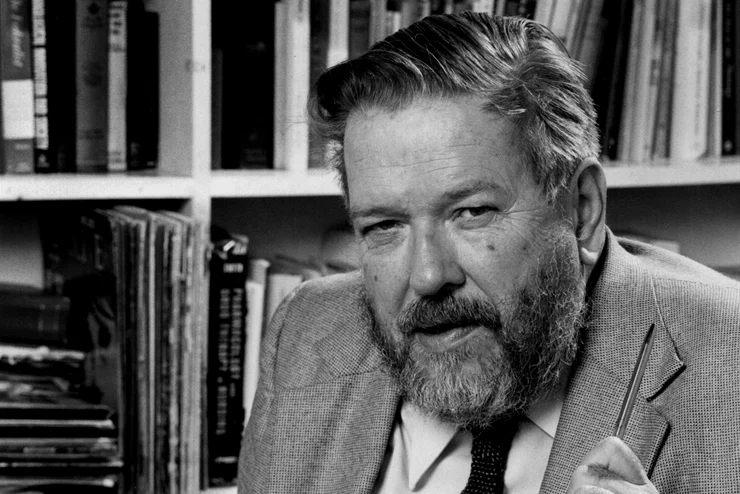
George Grant (1918-1988) was an iconic Canadian philosopher, professor, and commentator. While he is best known for Lament for a Nation (1965) he wrote a number of other works including Technology and Empire (1969), which analyzes technology-driven globalization.
“Canada as always was involved in the general Western fate. Just read how English-speaking Canadians from all areas and all economic classes went off to that war [First World War] hopefully and honestly believing that they were thereby guaranteeing freedom and justice in the world. Loyalty to Britain and loyalty to liberal capitalist democracy was identified with loyalty to freedom and justice.”
“First, it killed many of the best English-speaking Canadians and left the survivors cynical and tired. I once asked a man of that generation why it was that between the wars of 1914 and 1939 Canada was allowed to slip into the slough of despond in which its national hope was frittered away to the U.S. by Mackenzie King and the Liberal party. He answered graphically: ‘We had our guts shot away in France.’ “
“Secondly, English-speaking Canadians in the name of that brutal struggle between empires forced French-speaking Canadians to take part in a way which they knew not to be theirs. If Canada were to exist, English and French-speaking peoples had to have sufficient trust to choose to be together rather than to be Americans. The forcing of the French by fanatics such as Sam Hughes [Canada’s Minister of Militia and Defence from October 1911 to November 1916, who was the driving force behind Canada’s early war effort. More than 66,000 of Canada’s service members gave their lives and more than 172,000 were wounded out of Canada’s small population of 7.2 million.] and the culmination of that process in the election of 1917 meant that the French Canadians saw themselves threatened more by English-speaking Canadians than by the deeper threat to the south.”
“The third great effect of that war in Canada was due to the policies of the ruling classes in Great Britain. In the face of the competition from other European empires, the British ruling classes acted as if their only hope of continuing power was to put their fate into the hands of the American empire. That process is epitomized in the career of Winston Churchill. High rhetoric about partnership among the English-speaking peoples has been used about this process. It cannot, however, cover the fact that Great Britain’s chief status in the world today is to do useful jobs for its masters and to be paid for so doing by the support of the pound and the freedom to provide entertainers and entertainment for the empire as a whole. The American empire may be having its difficulties with France and Germany, but it does not have them with Great Britain. Leaving aside the complex question of whether this status was the best that the English could achieve in the circumstances, it is clear that its effect on the possibility of Canada being a nation has been large. The elimination of Great Britain as an independent source of civilisation in the English-speaking world greatly increased the pull of English-speaking Canadians to an identity with the centre.”
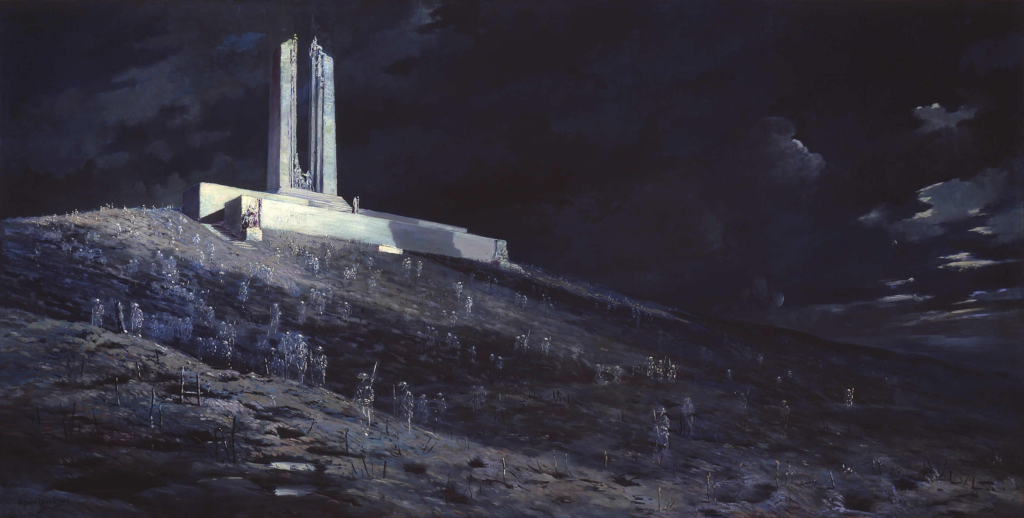
Ghosts of Vimy Ridge by William Longstaff – circa 1929. More than 66,000 soldiers from Canada and Newfoundland gave their lives in the First World War, and 172,000 were wounded.
“The dominant tendency of the Western world has been to divide history from nature and to consider history as dynamic and nature controllable as externality. Therefore, modern men have been extremely violent in their dealings with other men and other beings. Liberal doctrine does not prepare us for this violence because of its identification of technology with evolution, and the identification of evolution with movement of the race to higher and higher morality. Such a doctrine could not understand that an expanding technological society is going to be an imperialist society even when it is run by governments who talk and sometimes act the language of welfare both domestically and internationally.”
“To live in a world of these violent empires, and in a satellite of the greatest of them, presents complex problems of morality. These problems may be stated thus. In human life there must always be place for love of the good and love of one’s own. Love of the good is man’s highest end, but it is of the nature of things that we come to know and to love what is good by first meeting it in that which is our own–this particular body, this family, these friends, this woman, this part of the world, this set of traditions, this country, this civilisation.”
All content on this website is copyrighted, and cannot be republished or reproduced without permission.
Share this article!

The truth does not fear investigation.
You can help support Dominion Review!
Dominion Review is entirely funded by readers. I am proud to publish hard-hitting columns and in-depth journalism with no paywall, no government grants, and no deference to political correctness and prevailing orthodoxies. If you appreciate this publication and want to help it grow and provide novel and dissenting perspectives to more Canadians, consider subscribing on Patreon for $5/month.
- Riley Donovan, editor