Editor’s note: Despite sharing a similar name, Dominion Review is not affiliated with Dominion Society.
Most attendees agree that the Dominion Society’s inaugural national conference, held in a surprisingly shiny and sophisticated corporate hall outside Burlington Ontario, was a success by almost any metric. I claim to say this unbiasedly, as someone who was not only outside the organizational team, but who remains skeptical of remigration as a central organizing issue.
What are these metrics of success?
First and foremost, the gathering evoked the type of confidence and collective pride that is vital to the growth of any political movement. After meeting at a clandestine Oakville parking lot to receive the event location, and being surprised with a warm welcome by masked counter protesters who somehow discovered our location, I hopped in a truck with another member, and reached “the Atrium”, a towering clear glass building.
But, when I say the gathering evoked “confidence”, it had little to do with the building we were in, but the quality of the character I was surrounded by. The men and women in attendance proved consistently in conversation to be charming, and intelligent; of good stock, and strong stature. Gentlemen overwhelmingly wore suit jackets and dress shirts, while ladies wore classy dresses and other feminine attire. Socialization was enjoyable and agreeable, rarely socially awkward, and occurred with a certain intensity and vigour previously not associated with the Canadian right. Around me were familiar faces, the descendants of those who shaped this country for generations. What had coalesced in this hall was a new counter-elite, one who self-identified as such.
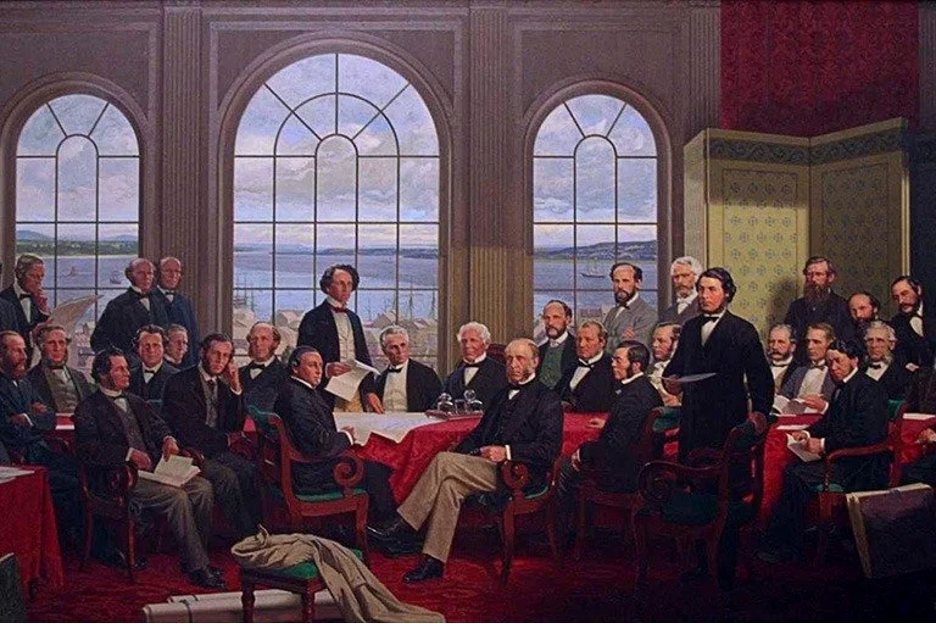

The conference opened with the singing of O’Canada. To my bewilderment, as I told the lad beside me, this was the first time I had sung the anthem under the Red Ensign banner. The flag itself must have been woven in the early 20th century, or even earlier. Goosebumps rolled down my spine as we stood on guard for thee, singing as one. No awkward stutters, no scrambled harmony, no lyrical revisionism. We sang with power and glory. And at the end, we celebrated, understanding there was a vibrant and largely unprecedented energy in the room. Perhaps it was simply the fact that, as a man in his twenties, I have seldom felt a collective sense of Canadian national pride. Or, perhaps this was truly special.
Naturally, not everyone was vanguard material. The young man who drove me to the Atrium did not take much interest in electoral politics or moral philosophy, but intuitively and viscerally understood the dire reality of demographics in Canada and across the West. I found him quite materialistic, and superficial around issues of remigration and multiculturalism, lacking substance beyond a humorous disgust of the third world. But these dispositions were in spite of the general culture of the conference, not representative of it. The keynote speakers, among them John Carter, Alexandre Cormier-Denis, Fortissax, and Charlie Downes, were each a blend of passionate and articulate, demanding an intermediate depth of thought from their listeners. The conference made it clear that the priority of the Dominion Society is not to rile up the masses, or pitch slogans to the public, but to train the next generation of political leaders, particularly, but not exclusively, from English Canada.
However, the conference also showcased particular divisions within the domestic dissident right that, by nature of their success, the Dominion Society has found themselves at the centre of. The speech by Mr. Downes, which argued that the Christian faith must be at the heart of the “revolutionary right” in the 2030s and beyond, received a standing ovation, and an ardent chanting of “Christ is King”. Although the vast majority joined in unison, there were several who remained seated and silent. This, as I confirmed when speaking to a few afterwards, is representative of a spiritual divide between those who view Christianity as cardinal to the hearts and minds of Western man, and those who follow pre-Christian, European faiths. Downes’ speech, and the overwhelmingly positive reaction to it, made it clear that the Canadian revolutionary right is predominantly under Christ, in the footsteps of many of our Loyalist ancestors. How far do we look back in the past to discover the authentic and “true” religiosity of our people? This was a question posed by John Carter; and it remains not entirely answered.
The event concluded with a showing of emotions from Mr. Tyrie, Chairman of the Dominion Society, after weeks of external pressure and extraordinary levels of sabotage and uncertainty. Pride he expressed, in the organization’s growth, selflessness, and seriousness of purpose. It was, and is, an authentic movement, despite what government aligned sources have to say about “Fed” or Conspiracy.
As I looked out into the sea of faces, I did not see abnormality; not radical, or fringe. I saw the face of a person who could be my doctor, my next-door neighbour, my cousin. In other words, movements that in a previous day would scare everyone but the most intensive of obsessives, are increasingly attractive to “normal” people, with healthy relationships, and trained in a professional discipline. There are more of us than we think, as Dominion Society’s 2026 National Conference proved. Watch what happens next.
All content on this website is copyrighted, and cannot be republished or reproduced without permission.
Share this article!




The truth does not fear investigation.
You can help support Dominion Review!
Dominion Review is entirely funded by readers. I am proud to publish hard-hitting columns and in-depth journalism with no paywall, no government grants, and no deference to political correctness and prevailing orthodoxies. If you appreciate this publication and want to help it grow and provide novel and dissenting perspectives to more Canadians, consider subscribing on Patreon for $5/month.
- Riley Donovan, editor