
“Save $90 Billion. Stop Alto.” Thus ran Pierre Poilievre’s lectern as he gave a speech on March 31st at a farm near Keene, Ontario. The Leader of the Opposition was speaking out in opposition to the proposed 1,000 km high-speed rail line between Toronto and Quebec City connecting most of the Quebec City–Windsor corridor. He cited two primary grievances: the cost of the construction, and the potential for expropriation of land for the project.
This stance was widely panned on X (formerly Twitter) by all sides of the political spectrum. Conservatives, Nationalists, Liberals, and New Democrats all seemed unified against Pierre Poilievre’s “baffling” political strategy. On the other side, defenders of Poilievre’s position appealed primarily to the size of the national debt.
Alto, the Crown corporation in charge of the construction of the rail line, estimates the project to cost between $60-$90 billion. Canada’s national debt currently stands at $2.3 trillion, with a 2025 deficit of roughly $90 billion, comparable to the cost of the proposed line. However, appeals to the cost fail to account for the project’s timeline.
Alto states that the high-speed rail line will be constructed in at least five 10-year phases, each representing a leg of the line between urban centres. Presuming this reflects reality, then the $90 billion would be spread out over a span of approximately 50 years. This would mean that – using the higher estimate – the project would cost $1.8 billion annually.
To put that in perspective, this year Conservative Ontario Premier Doug Ford announced a $31 billion highway expansion and rehabilitation plan for the next 10 years – including the construction of proposed Highway 413. That is $3.1 billion annually for construction of a highway estimated to save only 30 minutes on a commute.
Approximately 9 million people will be served by Highway 413. At speeds exceeding 300 km/h, the Alto rail line would serve approximately 18 million people – just under half of Canada’s population, and save hours in commute time.
Besides commute time reductions, high-speed rail carries with it a number of clear benefits. In 2011, the Ministry of Transport of the Province of Ontario conducted a study into the feasibility of high-speed rail to service the Quebec City–Windsor corridor and they reached the following conclusions:
- High-speed rail would generate billions of dollars for every urban centre along the corridor.
- As proven by other G7 countries, high-speed rail would be safer and require less maintenance than the existing VIA rail network.
- High-speed rail lifts the burden of cost off the commuter during times of fuel insecurity.
- Decreases in congestion and highway usage due to the rail would ease maintenance costs for highways across the corridor.
- Net project value would be greater than operating costs of public transit that is taken for granted (particularly VIA rail).
- There exists a strong public mandate for high-speed rail, and “81 percent of respondents felt that HSR would help to stimulate the economy and create thousands of jobs in a time when economic stimulus was needed.”
- Finally, the construction of high-speed rail along the Quebec City–Windsor corridor would serve as the beginning phase of “master planning,” allowing for eventual service of all of Canada by high-speed rail networks.
These benefits are not just “pie-in-the-sky” as Pierre Poilievre suggests, since almost identical results were found when the Van Horne Institute conducted its own study into high-speed rail between Calgary and Edmonton in 2004.
The study concluded that building high-speed rail would result in “$6.1 billion in benefits to users, in jobs and employment income and additional tax revenues for Alberta and the federal government, as well as significant qualitative and other benefits in support of Alberta’s future economic growth.”
Further detracting from Poilievre’s opposition to the railway, the Conservative Party under Stephen Harper directly backed high-speed rail development along the very same route the Liberals are suggesting.

In 2009, Tory Senator Leo Housakos had this to say in response to increased government funding to rail transport: “I think this is an opportunity with high-speed rail to take Canada into the 21st century with an infrastructure program that’s environmentally green, that can create tons of jobs, and can really connect this country quickly, especially starting off with the Quebec City–Windsor corridor.”
At that same time, Conservative MP for Peterborough Dean Del Mastro led a Parliamentary committee advocating for high-speed rail across central Canada.
If such a strong Conservative mandate existed 15–20 years ago, what changed? I think Jason Kenney’s response gives us insight into the answer. On X, former Premier of Alberta Jason Kenney reposted Poilievre’s announcement with the following caption:
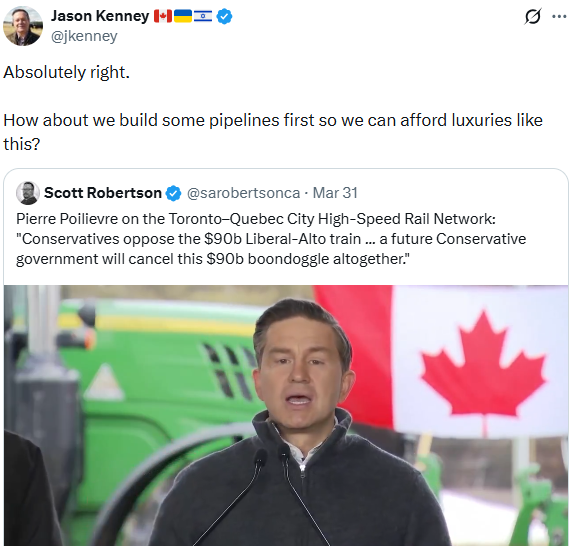
Since when was infrastructure a “luxury?” Was it a “luxury” in 2014, when Jason Kenney said the Northern Gateway pipeline was not a national priority?
Rail and pipelines are not mutually exclusive. Even if they were, as Kenney suggests, the Conservative Party has failed to pursue them any more effectively than the Liberals.
In September of 2025, Tegan Hill of Fraser Institute blamed the Liberals for the failure of Alberta’s pipeline development, writing: “a year after taking office, the Trudeau government simply cancelled the Northern Gateway pipeline.” This overlooks the fact that in June of 2014, Stephen Harper announced an approval that came with a staggering 209 conditions for construction. These same conditions would be nearly identical to those later enshrined in law under the Trudeau government.
Now these clauses, policies, and conditions are being tossed around like a game of hot potato to shift the blame for which party has caused the stagnation in development of pipelines. The simple fact is, Canada has consistently failed to build pipelines effectively – irrespective of the government in power.
It is not just the federal government, either. Alberta has had the opportunity to diversify away from reliance on pipelines as long as such an issue has been in discussion, but has consistently neglected to do so.
The Government of Alberta has never fully invested in pursuing domestic oil refining. You may point to programs like the $1 billion for partial oil upgrading facilities in 2018, but as history shows, you need to plunge much further than the comparative toe in the water that a mere $1 billion represents.
Adding to that is the fact that upgrading simply transforms bitumen into synthetic crude oil, whereas the majority of profits lie in gasoline and diesel, which is produced at refining facilities.
What this debate ultimately reveals is not a disagreement over rail versus pipelines, but a deeper issue: Canada has become unwilling to invest in its own development. At every level, and by nearly every party, genuine development in Canada is being stalled.
Canada is afraid of investing in itself. The Conservatives say that high-speed rail is a negligent use of funds, but when Sir John A. Macdonald’s government began construction of the Canadian Pacific Railway, the government at that time invested $25 million.
The total gross domestic product of Canada in that year was $581 million, meaning that in just one year, the government invested 4% of its GDP into building the railway.
In contrast, Canada’s GDP in 2025 was $3.2 trillion, meaning that an annual $1.8 billion represents just 0.05% of GDP invested in the Alto high-speed rail project. Even if the entire 50-year, $90 billion project budget was to be done in one year, that would still be just 2% of GDP.
While GDP is not a perfect measure of government capacity, the comparison remains illustrative.
The central point is this: Canada must spend if it is to escape the staples trap of larger powers exploiting us for our natural resources. If we ever want to do anything other than ship our economy overseas, then we must be prepared to make large and swift investments into our country.
The Liberals will not do this. Even with how much I have defended the Alto project, I ultimately do not believe in the Liberal government’s ability to make good on their promises regarding it. That does not mean, however, that the Alto project is inherently flawed, and Pierre Poilievre’s insistence on coming out against the project – to the extent that he has vowed to cancel it – reflects a broader failure to think seriously about national development.
Under Harper, the Conservatives promised to build things and failed to do so – the same is true for the Albertan Conservative government.
What do you think is the likely outcome for a Prime Minister who has now gone on the record that he will cancel funding for infrastructural projects that are vital to Canada’s longevity in the future?
As for myself, I am not inspired with confidence.
All content on this website is copyrighted, and cannot be republished or reproduced without permission.
Share this article!




The truth does not fear investigation.
You can help support Dominion Review!
Dominion Review is entirely funded by readers. I am proud to publish hard-hitting columns and in-depth journalism with no paywall, no government grants, and no deference to political correctness and prevailing orthodoxies. If you appreciate this publication and want to help it grow and provide novel and dissenting perspectives to more Canadians, consider subscribing on Patreon for $5/month.
- Riley Donovan, editor