
In a previous article, I discussed the way in which nationalistic Red Toryism was supplanted by the more continentalist Blue Toryism. This article will go through the after effects of this supercession, and try to discover the lost Canadian autarky.
For the benefit of the reader I will briefly describe the term autarky. Essentially, autarky is the concept of any given state achieving total economic self-sufficiency. All resources, services, and finances required for the function of the state being operated by and for the benefit of the state and its people.
The concept of autarky first emerged in the ashes of the Bronze Age Collapse, when the Greeks devised the system in order to try and fireproof themselves against such civilizational devastation in the future.
We can see the practical application of this attitude in the prototypical government structure of Ancient Greece; the city state.
Autarky’s pervasion in Greek thought can also be seen amongst Plato and Aristotle’s writings on politics. Plato in particular describes his ideal city state in The Republic. In the text, he outlines what the proper size of the city ought to be as follows:
“What should be the limits of the city? How shall we instruct our rulers concerning the city’s proper size? What are the best geographical boundaries, beyond which the city ought not to expand? I think the answer is this: let the city grow as long as there is unity among its inhabitants and consent to its government. Let our city be neither small nor large; let it be united and self-sufficient (αὐτάρκεια, autarky).”
Aristotle expands on the concept of autarky to a greater degree in his work The Politics wherein he says the following:
“When several villages are united in a single complete community, large enough to be nearly or quite self-sufficient, the state comes into existence, originating in the bare needs of life, and continuing in existence for the sake of a good life. And therefore, if the earlier forms of society are natural, so is the state, for it is the end of them, and the nature of a thing is its end… the final cause and end of a thing is the best, and to be self-sufficient is the end and the best.”
Famously, Prime Minister Mark Carney described Canada as the Athens to America’s Rome. So, why then have we as Canadians failed to heed the word of these most famous Athenian scholars?
It is my intention to investigate the history of the autarkical National Policy, the development and stagnation of Canadian infrastructure, and what we can do now to make Canada (as in the words of Plato) “united and self-sufficient.”
Intermittently throughout Canadian history we have pursued massive, nation-building projects. The bulk of these occurred in the period from 1885 through 1945, with the final nation-building project – the Trans-Canada Highway – being finished in 1971. Since then, the scope and persistence of infrastructural projects in Canada has been diminished to a nearly indiscernible level.

The time from 1885-1945 being the consensus for Canada’s epoch of national development is fascinating, as this date range perfectly coincides with the rise and subsequent deconstruction of Canada’s National Policy.
Introduced by Sir John A. Macdonald in the 1880s, the National Policy was a series of economic and security strategies to protect the nascent Canadian nation from encroachment by our southern neighbour.
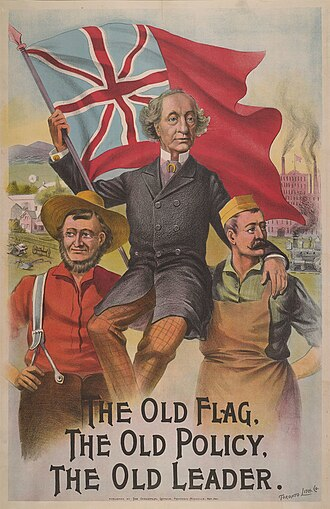
Many points of national pride can be traced back to this policy, or series of policies, such as the Canadian Pacific Railway, manufacturing in Eastern Canada, and vast agriculture, resource, and mineral capitalization in Western Canada. This was not made possible merely by investment, but by intelligent foreign policy as well.
In the early years of Canadian industrial development, the Canadian government, following the precedent set by many other previously emergent economies, placed tariffs on American goods in targeted manufacturing sectors. Mainly, the targeted products were heavy industrial goods and mining products.
At first, the tariffs received mixed reception from the public at large because of the price hikes immediately incurred due to domestic inability to produce according to need. However, once Canadian production caught up with demand, an understanding of the benefit of a high degree of domestic industry and manufacturing was recognized.
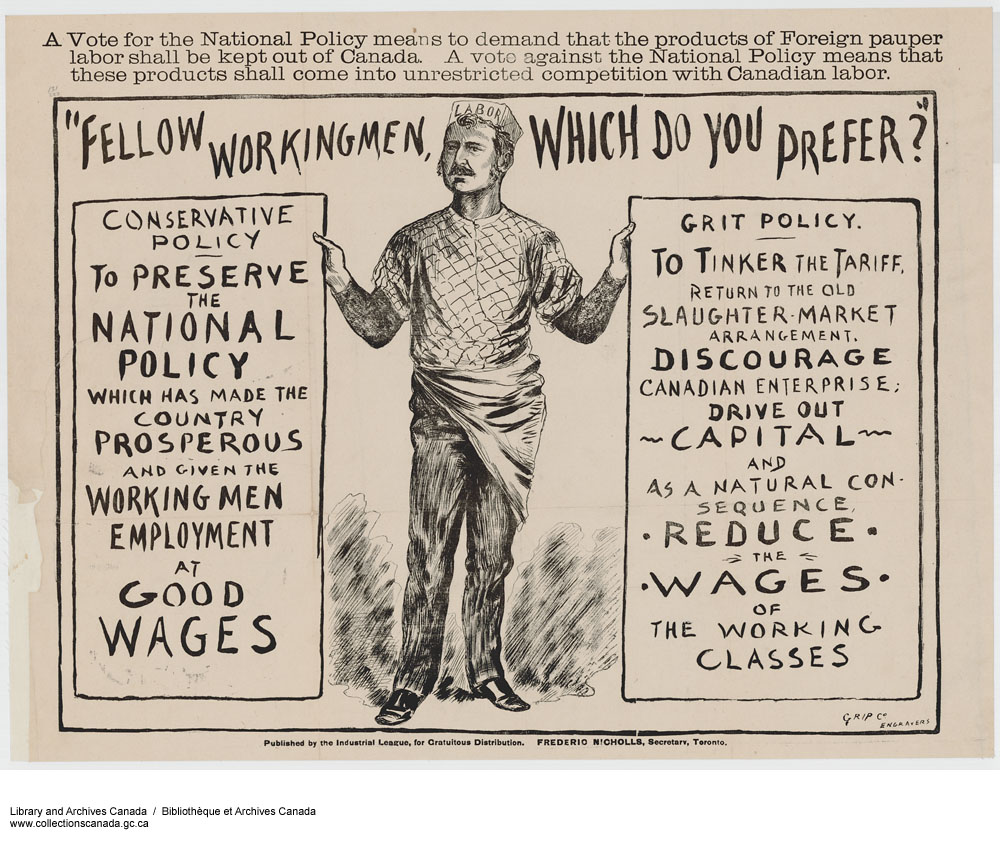
So, in 1911, when Laurier came out with a reciprocity agreement in order to reopen trade with the Americans, he was voted out in a landslide in favour of protectionist Conservative Robert Borden.
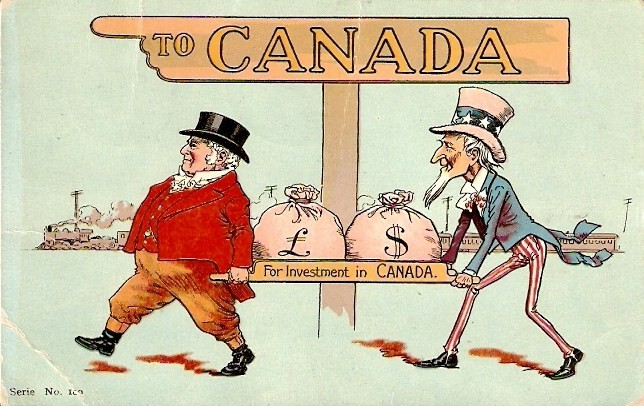
It was by virtue of these security policies and the tariffs implemented under the National Policy that the stage could be set for staple Canadian industries to flourish. Imperial preference allowed overseas investment in the economy, without the exploitative pressures that were incurred by American reciprocity.
This system of government investment, market protection, and infrastructural development led Canada to rapidly develop from a series of scattered colonies, into a robust and united country in the coming 20th century.
Canada has historically relied on staple industries – this is why they have become so integral to our identity. The identification and study of this aspect of Canadian economy was first explored by economist Harold Innis at the climax of this expansion and development.
Staple thesis, as it would come to be known, essentially posits that our economy is built on the backbone of our natural resources, and that how we manage those resources would be the ultimate decider in the progression of our nation.
When it came to the staple thesis, there were two main perspectives; contemporary W.A. Mackintosh believed that once the cost of importation of goods to supplement our staple resources surpassed the income from export, it would force the Canadian economy to “mature.”
However, Harold Innis was not so optimistic. Innis believed that this state of import surpassing export would not occur, or in the event that it did, that it would not motivate policymakers to action. The Canadian Centre for Policy Alternative’s book on staple thesis describes Innis’ position as follows:
“So long as profit margins were higher in a staple than elsewhere (say manufacturing) the less profitable sectors had difficulty attracting capital and labour. But the staples sector was vulnerable to a market collapse, with dire consequences for the society developed around its previous high returns on investment. This was the dreaded ‘staples trap.’”
This meant that the Canadian economy would be entirely reliant on larger, pre-existing “mature economies” in order to maintain our state in the midst of these market collapses. Yet, during boom times, the income from export of staples would be sufficient to placate the nation.
Complacent with the status of the economy, built on the foundation of this “staples trap”, they would not see the need to diversify.
Sadly, Innis would be proven right when the Liberal Party deconstructed the National Policy in the 1940s, and we focused our efforts on international trade – rather than nation-building.
Irrespective of which staple theorist’s model you believe in – Innis or Mackintosh – our financial system and national fate will be entirely dependent on our dedication towards nation-building.
So, what motivated our government to dismantle systems to promote nation-building projects?
Well, as shown in the annals of Canadian history, our nation-building is predicated on two major factors: anticipation of necessity, and urgent lump investment.
A prime example can be seen in the rapidity of the construction of the Canada Pacific Railway.
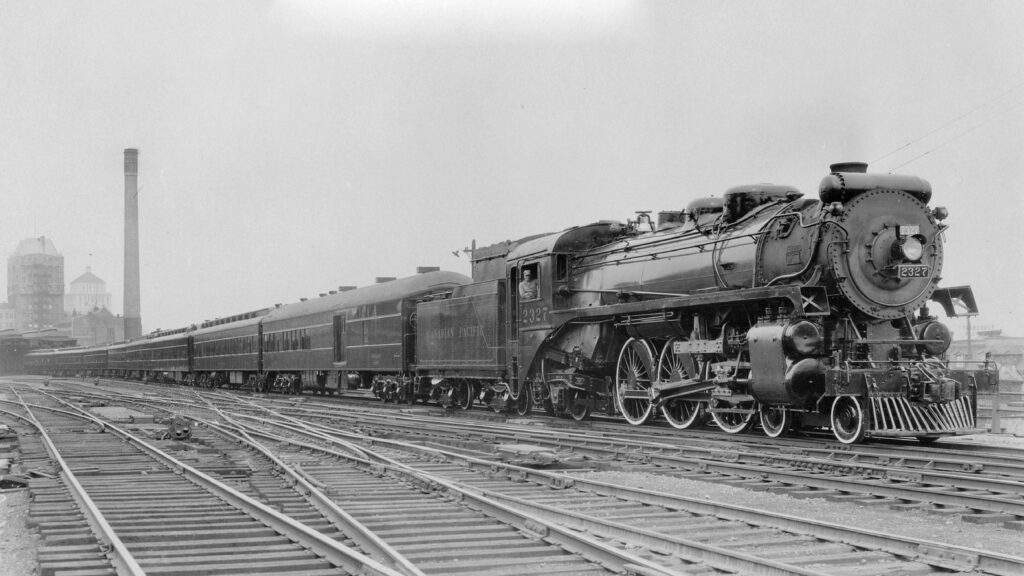
The Canadian Pacific Railway was approved by the CPR Act of 1874, with some work being completed in 1875. However, with Sir John A. Macdonald being relegated to Opposition as a result of his resignation for his part in the Pacific Scandal, the Liberals would dawdle on the Railway.
In 1878, Macdonald would return to power, and after acquiring the necessary government spending in 1880, he would devote a lump sum of $25 million. Now, it is hard to get an exact estimate for the inflation on that from 1880, but $25 million in 1914 (which is when the Bank of Canada’s inflation calculator begins) adds up to nearly $700 million.
With construction beginning in 1881, it would take a mere four years for the railway to be completed, with the final spike being driven in November of 1885, in Craigellachie, British Columbia. Despite factors like bureaucracy, elections, and the violent unrest from Louis Riel’s North-West Rebellion in 1885, the project that was conceptualized in 1874 was completed in 1885 – eleven years.
In the Canadian Pacific Railway we can see both principles of nation-building fulfilled. The anticipation of necessity was demonstrated in the foresight of value in the undeveloped West, and the project’s stipulation for British Columbia’s entry into Confederation. Urgent lump investment can be found in the expenditure to the equivalent of nearly a billion dollars being invested in the railway.
Let us compare the CPR to a very similar trans-continental transportation and logistics project: the Trans-Canada Highway.
In 1919, the Conservative government, under the continued echoes of the National Policy, approved the Canada Highways Act. In the following Great Depression and Liberal governments of the 1920s, the government spent $19 million on the expansion of a purely domestic Canadian Highway to stimulate financial stability.
Unfortunately, problems beset this project in the realm of federal and provincial jurisdiction on the construction of highways. It would stagnate until the Liberals felt the need to prove their ability to continue to build projects in the absence of the National Policy.
They would pass a further act in 1949, which would later be known as the Trans-Canada Highway Act. While this would not eliminate the jurisdictional problems, they hoped to stir the provinces to action by providing 50% of the funding for the highway.
This act set out an estimated completion date of 1956. However, when that time came, not a single province had completed their sections of the Trans-Canada Highway. One year later, in 1957, Saskatchewan would become the first province to achieve this honour.
But the road to span the continent had a lot further to go.
A major hurdle to overcome in the construction of the Trans-Canada Highway was the intrinsic issues with the chosen route. Major sections of the Ontario leg of the highway ran through swamps, which had no roads or any prior infrastructural development.
The final issue with routing would be the decision to take the highway through the Rogers Pass, rather than building upon the pre-existing interprovincial highway in the more southern Crowsnest Pass. Since it was further north, the Rogers Pass experienced extreme levels of snowfall and frequent avalanches, and when surveyed, it was estimated that the highway would have to be closed for 75 days of the year.
Thankfully, in 1957 – the same year Saskatchewan finished its stretch – Conservative John Diefenbaker would achieve the premiership. Five years later (thirteen years after the Trans-Canada Highway Act passed), the issues which plagued the project would be overcome, and the grand opening of the Trans-Canada Highway took place at the Rogers Pass.
A difference of only two years may not seem significant when it comes to the comparison of the Canadian Pacific Railway and the Trans-Canada Highway.
However, it is important to consider that nearly all construction of the CPR took place in the four years hitherto its completion, rather than the complete eleven year stretch from conception to completion. The Trans-Canada, by comparison, was under active construction for the whole thirteen years.
We can find the reasons for this in a returned consideration of the two principles of nation-building.
By 1949, cars had become a fact of life, and the provinces had already begun their own intra-provincial projects for building highway systems to connect their polities. The federal government coming in and telling them to build long stretches of highway in snowy mountains or murky swamps was less than appealing.
This also plays into the failure of the second principle. The Trans-Canada Highway Act only granted 50% funding from the federal government for the project. Though, after some negotiation, certain stretches were 90% funded federally, the general hesitance to perform widescale investment in the project severely delayed its completion.
What this demonstrates is that when we reached a certain level of fiscal development, the Canadian Pacific Railway permitting a comfortable degree of staple resource extraction, we no longer bore the necessary imminent desire to domestically invest lump amounts in further megaprojects.
There is an interplay between two major factors that fulfill the prophecies of Innis. Parliament’s democratic structure means that the government of the day – if it wishes to remain in power – must propitiate the people.
Firstly, people do not like it when the government spends money, especially when that money is being spent on a project they do not think they need.
Secondly, capitalism relies on the laws of supply and demand. Our capitalistic system is resistant to trying to fill a need before it arises. Yet, of course, if infrastructure is to be valuable, it must predate a need.
Together these factors work to massively disincentivize our government from pursuit of building on a large scale and meeting the two principles of nation-building: anticipation of necessity, and urgent lump investment.
Which is why Innis ends up being correct, and the Canadian government waits until needs become problems, then begs for money from already matured economies.
Further evidence of this prophetic fulfillment can be found in the history of the St. Lawrence Seaway – the starkest example of the Canadian government dallying on satisfying an economic need as a result of hesitancy from the hurdles of meeting the two principles of nation-building.
Dating back to the earliest periods of colonization in Canada, we built locks and canals to access the sea from our river port cities.
After the War of 1812, the Canadian colonies pursued projects to strengthen our maritime independence, which culminated in the construction of the historic Rideau Canal. By the time of Confederation, nearing the conclusion of the 19th century, there was a complex system of interlocking waterways.
Much like with the Canadian Pacific Railway, however, there was a growing desire to consolidate these disparate waterways into a singular seaway. This feeling resulted in the formation of the Canadian Deep Waterways Commission in 1895, which would become an international commission in 1909.
Nevertheless, focus was placed elsewhere, and it was not until the reconstruction of the Welland Canal in 1932 that any steps towards a consolidated seaway would be made. Canada and the U.S. signed the Great Lakes – St. Lawrence Deep Waterway Treaty, but no action was taken.
Moving at a snail’s pace, finally in 1949 amidst the approval of other infrastructural megaprojects, public interest began to boil over and the government took concerted effort in the pursuit of constructing what would become the St. Lawrence Seaway.
Compared to the fast pace of other Canadian infrastructural projects, there was one main reason why the St. Lawrence Seaway was taking so long. It was the insistence of the government, since the 1909 formation of the Canada-U.S. canal commission, to involve the United States in the project.
We lacked the will to spend the lump money necessary to construct the seaway, and wanted to siphon that money from the United States – demonstrating the forgoing of the second principle of nation-building. On the other hand, the Americans recognized that a large seaway in Canada would benefit us more than them, and so had no interest in bankrolling the project.
It was not until we signed the St. Lawrence Seaway Authority Act and the International Rapids Power Development Act in 1951 that the Americans were duped into giving us remittance. As unfortunately our government did not have a real interest in using these acts to construct the seaway, the passing of the acts was a mere scheme to extort American monies.
The government of the United States knew that, even though investing in the seaway would benefit us more than them, having no hand in it would be a major step towards our own economic maturation at their expense.
So, the Americans finally came to the negotiation table in earnest, and became a major partner in the St. Lawrence Seaway, ensuring that the bulk of our export economy would be dependent on them. This is the exact kind of reliance on mature economies which Innis spoke of.
Therefore, the accusation that Canada is an exploited hinterland whose only value is the production of staple resources for other countries is far too accurate.
Our hesitance and complacency lies not just in the infrastructure projects of the past. We see it in the only modern infrastructural project that we discuss to any realistic degree: the construction of a pipeline so that we may more efficiently ship the oil reserves under our feet to be refined and profited off by others.
Canada has the fourth largest reserves of oil in the world behind Venezuela, Saudi Arabia, and Iran, but we will not construct our own refineries from which to profit off of that oil effectively.
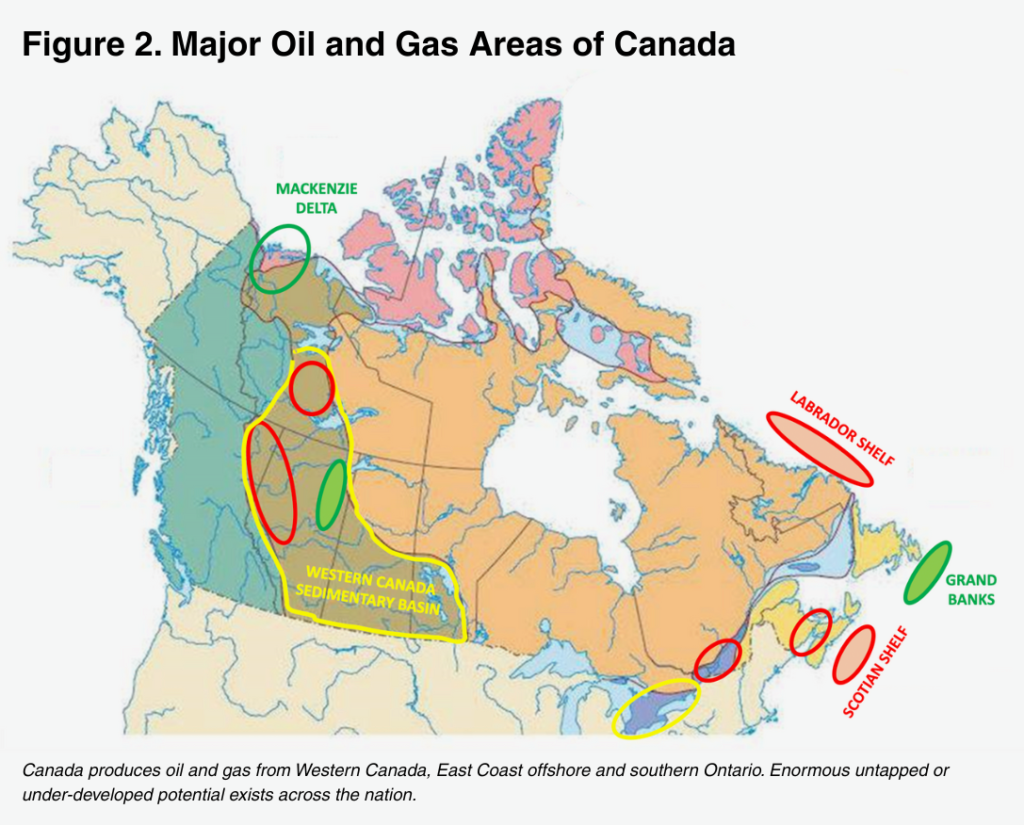
When we sell our crude oil to the United States, we do so at $60-80 USD per barrel. They then turn around and sell the refined petroleum at ~$126 USD per barrel (42 US gallons at ~$3).
It costs about $2-3 to refine a barrel of oil, for a markup of almost double in some cases. We can compare the cost of constructing Canadian refineries ($10 billion each) to the $16 billion/year importation of refined petroleum from the United States. We can also consider the fact that the Trans Mountain pipeline expansion project has cost over $34 billion.
It seems fairly obvious what would be the superior investment for Canadian economic development.
We can further demonstrate the financial irresponsibility of our policies by comparing our approach to Norway’s. In comparison to our fourth spot on the global oil reserves charts, Norway sits at number twenty – yet their citizens receive significantly more direct benefits from their oil production. Norway’s “Government Pension Fund Global” ensures that each citizen receives approximately $340,000 from Norway’s oil successes.
There are two marketplaces that define the modern world. The marketplace of goods, to which oil belongs, and the “marketplace of ideas,” which is what we are currently immersed in the discussion of.
If Canadian autarky has been so thoroughly defeated in this latter kind of marketplace, why should we even care? Furthermore, what bearing do the thoughts of Bronze Age philosophers have on contemporary discourse? Is such an autarky even achievable in a modern globalized economy?
To tackle the first question, we need to look back on the tariff policies of Macdonald’s National Policy, and compare them with the most recent round of tariffs between the United States and Canada.
In order to understand why Macdonald’s tariffs succeeded in their goal of encouraging the development of Canadian industry, whereas Carney’s tariffs seem only to increase our cost of living, we need to inspect some careful verbiage I earlier employed.
“Targeted”. The reason why the National Policy tariffs were specifically placed on products of manufacturing and mining was that these two industries were in their advent during the Macdonald premiership. In contrast to today, where Canada has firmly placed its eggs in the American economic basket.
Starting in the 1970s and lasting until the 2000s, the Canadian economy cemented its shifted focus from protecting the progression of domestic manufacturing to promoting resource-based exports. Once again, we fell for the staples trap.
Now immersed in the staples economy, it is nearly impossible to benefit from the tariffs we impose. If you do not have domestic manufacturing to make use of the resources you are creating, then there are no products to replace the ones you are attempting to prevent from circulating in the domestic market.
What you are left with is the same products, but at a higher cost.
While grants from the government exist to promote manufacturing and nation-building, we are lagging behind so badly that it is obvious that mere facilitation is insufficient to maintain the quality of life that Canadians expect and deserve.
This is where we get to the second question. Plato and Aristotle lived in a time bereft of a great many luxuries which we take for granted in the modern day, and their ideas were influenced by the Greek’s system devised to insulate from the Bronze Age Collapse, but divorced from that calamity by time.
Much like the cradle of civilization, whose various kingdoms were indelibly interconnected in trade networks and dependent on resources that were inaccessible in their own domains, we now persist in a global echo of this web of interdependency.
The globalized economy is pervasive but not as permanent as we would be led to believe.
Now, more than ever, it is important to become self-sufficient, to not let the rising cost of goods in a land alien to ours be the cornerstone of our economy that could cause the whole building to collapse.
John Maynard Keynes, father of Keynesian economics, said the following in his article National Self-Sufficiency;
“The divorce between ownership and the real responsibility of management is serious within a country, when ownership is broken up among innumerable individuals who buy their interest to-day and sell it to-morrow and lack altogether both knowledge and responsibility towards what they momentarily own. But when the same principle is applied internationally, it is, in times of stress, intolerable—I am irresponsible towards what I own and those who operate what I own are irresponsible towards me… remoteness between ownership and operation is an evil in the relations among men…”
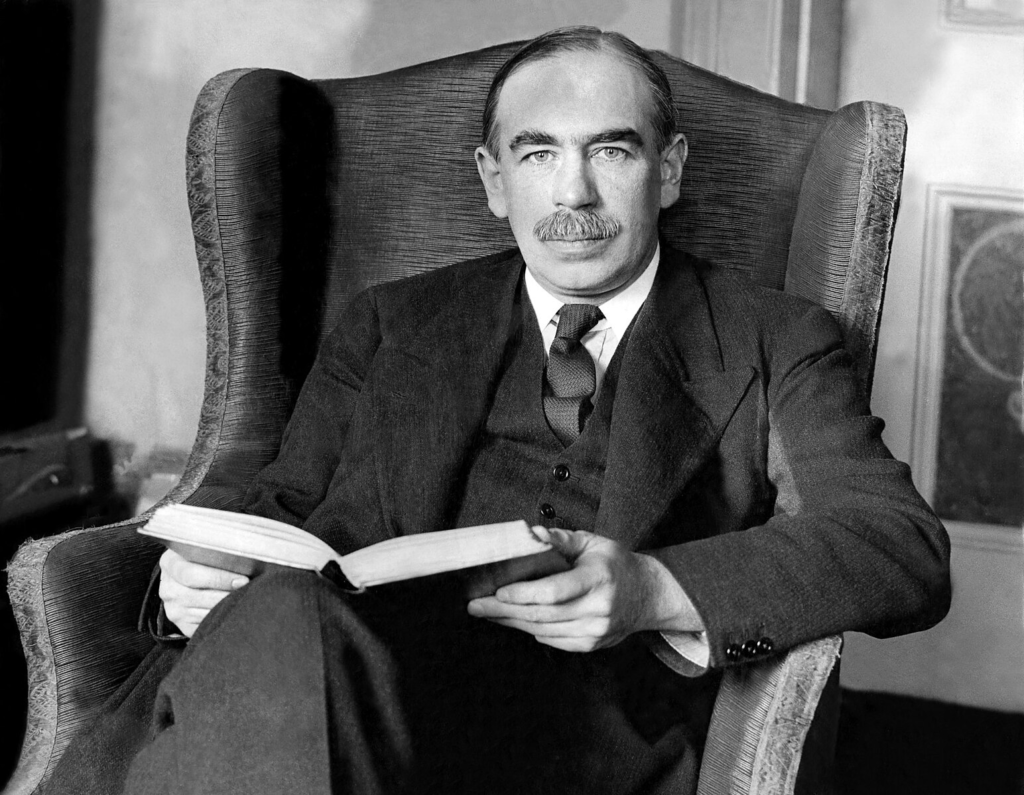
We see this in our own economy, when the only way to maintain any quality assurance in a product is to impose heavy consumer product regulations, as opposed to America’s characteristically blasé attitude. The international manufacturers have no burden of responsibility for the quality of products sold on the Canadian market – and vice versa, the Canadian people have no manner of recourse towards the international manufacturer for poor quality of goods.
So, even though the Bronze Age may have served as the birthplace of the autarkical idea, its principles remain just as prescient and pertinent today. Keynes continues: “National self-sufficiency, in short, though it costs something, may be becoming a luxury which we can afford, if we happen to want it.”
So though government grant funding in the realms of national economic development exists, yet is insufficient to bring us this luxury (not necessarily material, but civilizational), then what actions could we undertake to bring forward an autarkical or self-sufficient Canada?
- Nationalization of the natural monopolies (telecom, rail, power, etc.) under Crown Corporations.
- This could be permanent, or a stepping stone baseline competitor to provide services while domestic providers emerge. See; SaskTel.
- Total domestic repossession of our national railway network.
- Reform the governance of Crown Corporations to maximize Canadian national interest.
- Address geographic bottlenecks.
- As established earlier, one of the most difficult parts of developing Canada on a broad scale is our geography. We need to focus on seriously addressing our geography and expanding our existing infrastructure to maximize capacity for logistics movement.
- Reduce the final barriers for interprovincial trade.
- As we reduce our foreign market share, we need to replace those shares with alternative investors and exports.
- We need to eliminate the final trade barriers, particularly on food, which is 7% of our total GDP.
- Promote the establishment of co-operatives.
- As seen by the Hudson’s Bay Company, Tim Hortons, and a great many other prominent Canadian companies, private companies are particularly liable to foreign subterfuge.
- Co-operative corporations reduce the capacity for foreign interference, and generally maintain a culture of localism. This is useful for building products in Canada, and keeping them here.
- Strengthen anti-trust laws.
- To keep the Canadian economy growing, we need to keep it competitive. Non-monopoly industries ought to be kept fiercely competitive to maximize innovation and growth.
- Streamline domestic investment, discourage foreign withdrawal.
- Institute a distributed profits tax to replace the corporate tax on operating profits. This taxes withdrawals from businesses in place of taxing year-to-year earnings. Allowing corporations to expand quickly, taxes only become triggered when distributing their profits, rather than when the profits are made.
- Corporations in Canada would operate like RRSPs with tax-free growth, while also incurring additional cost to withdrawals in foreign countries.
- Replace current government funding schemes with a Crown Investment Bank.
- Modeled off La Caisse (Investment Board of Quebec Pension Plan), made up of professional investors.
- Regulated to prioritize wholly Canadian enterprises and industries that are areas of necessity.
- More directly encourages the growth of not only Canadian enterprises, but effective ones.
- End mass immigration.
- If we ever want to grow Canada’s economy, self-sufficiency, and quality of life, we must end reliance on foreign scab labour. Much like the staples trap, cheap foreign labour is a trap which makes our economy dependent on speculative growth, rather than matured financial gains.
- This would mean a temporary reduction in productivity, in exchange for long-term progression in efficiency and prices.
There are so many more policies that could be listed on a long timescale, but with these changes – some of which are trivial – we could seriously perform a Canadian economic miracle.
Most important to remember (and to quote Keynes once more) is this: “those who seek to disembarrass a country of its entanglements should be very slow and wary. It should not be a matter of tearing up roots but of slowly training a plant to grow in a different direction.”
If we sever ourselves off too swiftly in pursuit of this autarky, we could castrate our economy before it can become freestanding.
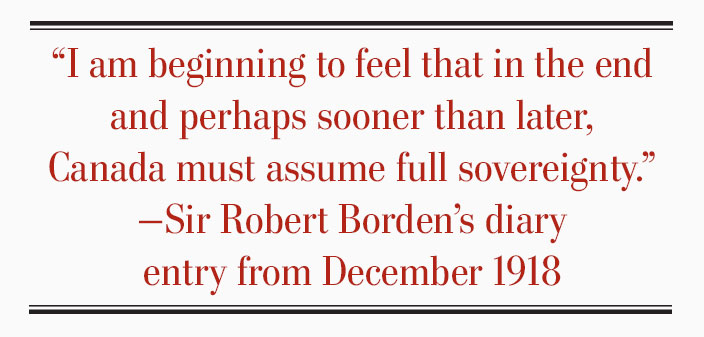
Canada’s sovereignty in territory, security, and economy must be foundationally insured for the sake of maintaining our continued existence. We can learn from the lessons of our foundational thinkers, the failures of our past governments, and the omens of our homegrown economists, to build a Canada that is resolute and resilient.
I leave with a simple question. Would you rather Canada be a frigid hinterland, exploited for our natural resources, or that we pursue policies that could cement our long-term sustainability at the cost of temporary discomfort?
All content on this website is copyrighted, and cannot be republished or reproduced without permission.
Share this article!



The truth does not fear investigation.
You can help support Dominion Review!
Dominion Review is entirely funded by readers. I am proud to publish hard-hitting columns and in-depth journalism with no paywall, no government grants, and no deference to political correctness and prevailing orthodoxies. If you appreciate this publication and want to help it grow and provide novel and dissenting perspectives to more Canadians, consider subscribing on Patreon for $5/month.
- Riley Donovan, editor