
Another day, another interview on Poilievre’s podcast tour – this one with Steve Bartlett, host of The Diary Of A CEO on YouTube. In a video with the ridiculous title “Pierre Poilievre: The Economy Is About to Collapse! America Is Making a Huge Mistake!“, a wide range of topics are discussed, from the Iran War to Stoicism.
While I have not watched the full interview, I did listen to the short sections devoted to immigration, in which Poilievre explained his support for a modest degree of immigration restriction. While the Conservative Leader was initially in favour of high levels of immigration, starting in 2024 he adapted his position to that of the Canadian public as shown in the polling data at the time.
Even in 2023, a year which saw Canada’s population soar by almost 1.3 million, a veritable tidal wave of humanity that strained our food banks, hospital emergency rooms, housing markets, roads, transit systems, and infrastructure, Poilievre still had not made up his mind. In December of that year, I published an article by Greg Walker titled “Poilievre, Stop Worrying and Seize the Immigration Opportunity“:
“If Poilievre is not talking about immigration because he is scared of a media reaction, he’s making a political mistake and needs to realign his rhetoric with the will of the people, the self-interest of the nation, and with Reason. If on the other hand he is a ‘true believer’ as his detractors say, a part of that waning breed of conservatives who genuinely think migration is a good policy for the country and compatible with their future electoral success, patriots have the urgent task of persuading him before the election that he’s wrong.”
Now, Poilievre supports some degree of immigration restriction. This is to be welcomed – I am not the type to get hung up about whether a politician’s policies are “genuine” or not (very little in their profession is truly genuine, after all). Nevertheless, it is important to remember that many of the MPs now pushing for immigration restriction pushed against it just a few years ago. This evolution of views shows the immense power held by the electorate in a country with a still relatively small population like ours.
As the immigration floodgates were opened after the pandemic and the population boomed, Canadians bucked the taboos and began to express their rage on social media, to each other in their families and communities, and to their MPs. Without a single paid lobbyist, their views were able to overpower the combined force of a business lobby made up of influential groups such as Restaurants Canada, Canadian Chamber of Commerce, Canadian Manufacturers and Exporters, and Canadian Federation of Independent Business.
What followed were two consecutive immigration cuts, under the Trudeau government and subsequently under Carney. Population growth has fallen to 0%, with a cavalcade of positive effects for regular Canadians. Most recently, we learned that price wars are starting to break out among the major cell carriers, who up until now had been able to keep plans artificially pricey thanks to demand from immigration. As it turns out, immigration restriction is even making phone plans cheaper!
Even with population growth momentarily stalled, the immigration debate continues, with a new poll showing that most Canadians want even further cuts. One of the key issues in the Canadian immigration file is whether the business lobby will be able to seize back control of the policy levers, bringing the country back to a renewed period of immigration-fuelled population growth after our temporary population pause is over.
This is why it is important to analyze how Canadian politicians are talking about immigration, taking note of rhetorical distortions so that we might be better equipped to correct them. Let us examine how Poilievre answered one of the immigration-related questions in his interview, and see where his answer falls short:
INTERVIEWER: “Across the Western world, the subject of immigration seems to be a bit of a winning formula for political leaders. If I think about the UK, what Trump said about, you know, being invaded by rapists and murderers from the southern border, do you feel that it’s a sort of a weaponized, divisive tool for people to get elected, complaining about the brown people or foreigners?
POILIEVRE: “I’ll just give you the Canadian experience. So for roughly 200 years, we had the most successful immigration system in the world by far. In fact, other countries, both Republicans and Democrats in the United States used to say “We need to study the Canadian system because it has been so successful.” We had a point system that measured whether someone would be a good fit for our labour market, whether they would would integrate well into our our system. And overwhelmingly, people integrated, intermarried, you know, my wife is a refugee from Venezuela. That is not an uncommon story in Canada. What we encountered was a very sudden and inexplicable increase in the numbers in the period from 2021 to 2024 that was strictly out of line with our ability to absorb people into housing, healthcare, and jobs. And this upset the social peace on immigration that we had had for two centuries leading up to it. And now everyone across the political spectrum agrees that it went too far, too fast.” [emphasis mine]

This is a very convenient explanation. Immigration worked exquisitely for 200 years (it is unclear why he keeps citing this number since that would put us in 1826), and then suddenly in 2021 the Trudeau government breaks the system. By this logic, all we would have to do is go back to the Harper immigration policy, or possible even Justin Trudeau’s immigration policy from 2015-2020. This argument lets all Conservative governments off the hook, while simultaneously excusing Poilievre himself for being pro-immigration up until very, very recently.
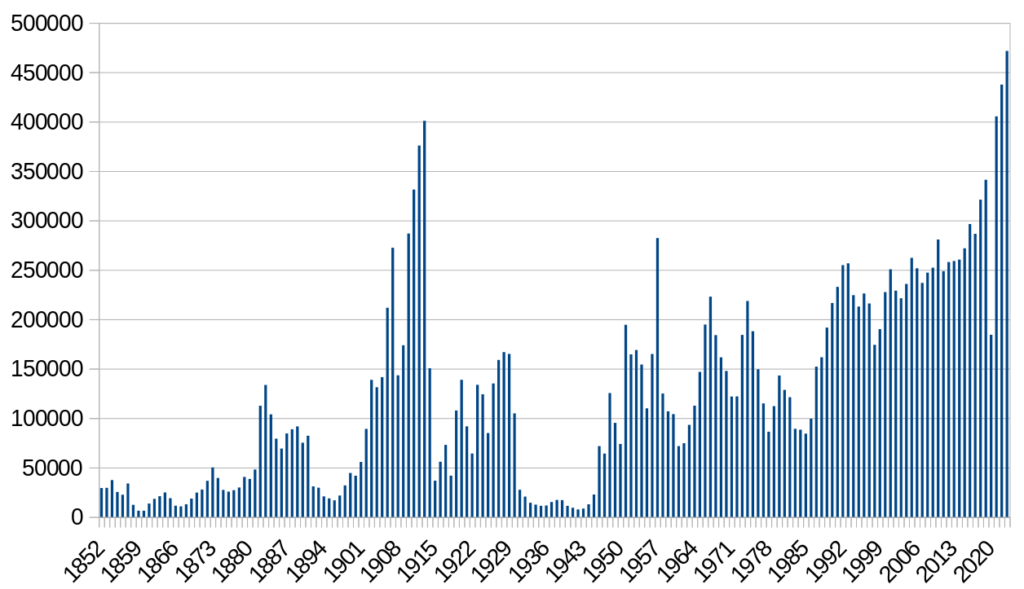
The problem with his argument is that it is not accurate. Below is a chart of Canada’s immigration levels over time. What you will notice right off the bat is that there were always ebbs and flows. For instance, a huge spike in the early 1900s, when the federal government was admitting large numbers of immigrants, including many eastern Europeans, with the express purpose of settling the Prairies to forestall US annexation of the region. During the Great Depression of the 1930s until after the Second World War, we see immigration has dropped off to nearly nothing.
This was known as the “tap on, tap off” policy. Towards the right hand of the chart, we find that the ebbs and flows are gone (with the notable exception of 2020, when the advent of Covid stopped most travel). That one year notwithstanding, the right side of the chart has become one never ending wall of immigration, without pause. This is because Prime Minister Brian Mulroney abolished our old “tap on, tap off” policy in 1990.
Here is how population expert Madeline Weld summarizes what I would argue was one of the worst policy decisions in Canadian history:
“In 1990, Mulroney’s immigration minister Barbara McDougall won a major cabinet battle when she succeeded in raising Canada’s target for immigration to 250,000 annually, regardless of economic conditions. Prior to that time, the number of new immigrants to Canada had varied from year to year, depending on perceived economic conditions.
McDougall would have known that her arguments for the alleged economic benefits of uninterrupted high immigration were on shaky ground given that immigrants who had come to Canada since 1978, when the family class was introduced, were less educated, less able to speak English or French, and had dramatically lower earnings than their predecessors. But she also mentioned a more credible reason for the change in policy – a new source of voters for the Conservative party.
Brian Mulroney’s successors, regardless of political party, maintained the annual target of 250,000, using the same bogus economic arguments. Of course, they too had an eye on the immigrant vote. And likely on the people who actually benefitted from mass immigration, such as bankers, real estate developers, and cheap labour employers, who could perhaps be counted on for political donations and other kinds of rewards.
So, despite warning signs both economic and social, not to mention the environmental impact and tremendous loss of farmland, Barbara McDougall’s high target was followed by Liberals Jean Chrétien and Paul Martin, and Conservative Stephen Harper. (Kim Campbell was not in office long enough to be held responsible for any policy.)”
This is the reality of Canadian immigration that Poilievre is either ignorant of or seeks to obscure. Since 1990, both Conservative and Liberal governments have imposed mass immigration on the Canadian public without our consent, at the behest of the business lobby and out of a self-interested and undemocratic ambition to harvest votes from ethnic blocs (this last aspect may be backfiring, as immigrants themselves are increasingly seeing through the mirage and realizing that immigration restriction is in their interest, too).
That final, astonishing spike on the very far right of the immigration chart, in 2021, was not the cause of Canada’s immigration problem – as Poilievre would have you believe. Rather, it was the year where Canada’s political elite overplayed their hand, and raised immigration levels so quickly that Canadians were suddenly jolted awake.
It would be in the interest of our political and business elite if we were now rocked back to sleep with soothing promises that immigration will be dialled back to 2019, 2015, or 2010 levels. Above all, immigration profiteers and their political allies are seeking to prevent an awakened and indignant population from demanding that the mass immigration policy inaugurated by Mulroney be abolished, and the historic “tap on, tap off” policy that prevailed from Confederation until 1990 be restored.
All content on this website is copyrighted, and cannot be republished or reproduced without permission.
Share this article!




The truth does not fear investigation.
You can help support Dominion Review!
Dominion Review is entirely funded by readers. I am proud to publish hard-hitting columns and in-depth journalism with no paywall, no government grants, and no deference to political correctness and prevailing orthodoxies. If you appreciate this publication and want to help it grow and provide novel and dissenting perspectives to more Canadians, consider subscribing on Patreon for $5/month.
- Riley Donovan, editor