
In the following essay I attempt to summarize Jacques Ellul’s complex work –The Technological Society – by bringing together selections which, combined together, constitute the highlights of his monumental work.
By the end of reading it becomes clear how humans are made to adapt to Technique rather than Technique adapting to human needs.
“In The Technological Society, Jacques Ellul formulates a comprehensive and forceful social philosophy of our technical civilization.
The Technological Society requires us to examine anew what the author describes as the essential tragedy of a civilization increasingly dominated by technique.
Despite Ellul’s forceful emphasis upon the erosion of moral values brought about by technicism, he has written neither a latter-day Luddite tract nor a sociological apocalypse.
He examines the role of technique in modern society and offers a system of thought that, with some critical modification, can help us understand the forces behind the development of the technical civilization that is distinctively ours.

The Technical Man is fascinated by results, by the immediate consequences of setting standardized devices into motion. He cannot help admiring the spectacular effectiveness of nuclear weapons of war. Above all, he is committed to the never-ending search for ‘the one best way’ to achieve any designated objective.
Ours is a progressively technical civilization: by this Ellul means that the ever-expanding and irreversible rule of technique is extended to all domains of life.” (Source: The Technological Society, Foreword, p. vi)
On this issue I wish to remind the readers of the progressively technical nature of student evaluation this author observed during a long academic career. As the years went by, increasingly multiple choice questions became the norm for evaluating student work based on the misguided belief that they were scientific and more accurately measured the student’s achievements in all academic fields, including the social sciences.
To illustrate the absurdity of this belief, I must describe the case of one student who came to my office when I was the Chair of the department. She was in tears, explaining that she was a straight “A” student, but had received a failing grade on this subject from her professor who refuses to listen to her explanation that she has answered the vast majority of multiple choice questions accurately.
I asked to have the list of questions the professor had given out and the student had answered. Then I phoned the professor and told him to provide me with his multiple-choice questions measuring sheet, the kind with holes that is put on top of the student’s answer sheet. At first glance it showed the student had answered all the questions wrong. Then I slid the measuring sheet one question further down. It showed that the student had answered all the questions correctly! There had been a minor technical error with the first question: The student had skipped it in error, but she had answered all the remaining questions correctly.
I explained to the student that she would lose five marks for that one error; otherwise her grade was 95%, an “A+”, the highest the institution offered. The student left my office happy that justice had prevailed. Then I called the professor, explained the technical error he had made in evaluating the student’s exam, and advised him the student’s failing grade was to be changed to A+ and that he had no choice in the matter.
I include the case here to illustrate the absurdity of application of technique when insight and human intelligence are called for. In all the years of academic teaching I always relied on essay exams that students wrote in class in my presence and refused to use multiple choice exams ever.
To quote from The Technological Society in relation to the above case: “It is the essence of technique to compel the qualitative to become quantitative.”
To return to Ellul:
“Politics in turn becomes an arena for contention among rival techniques. The technician sees the nation quite differently from the political man: to the technician, the nation is nothing more than another sphere in which to apply the instruments he has developed. To him, the state is not the expression of the will of the people nor a divine creation nor a creature of class conflict. It is an enterprise providing services that must be made to function efficiently.
He judges states in terms of their capacity to utilize techniques effectively, not in terms of their relative justice. Political doctrine revolves around what is useful rather than what is good. Purposes drop out of sight and efficiency becomes the central concern.
As the political form best suited to the massive and unprincipled use of technique, dictatorship gains in power. And this in turn narrows the range of choice for the democracies: either they too use some version of effective technique – centralized control and propaganda – or they will fall behind.” (Source: The Technological Society, Foreword, p. vii)
“Restraints on the rule of technique become increasingly tenuous. Public opinion provides no control because it too is largely oriented toward ‘performance’ and technique is regarded as the prime instrument of performance, whether in the economy or in politics, in art or in sports.
Not understanding what the rule of technique is doing to him and to his world, modern man is beset by anxiety and a feeling of insecurity. He tries to adapt to changes he cannot comprehend.
The conflict of propaganda takes the place of the debate of ideas. Technique smothers the ideas that put its rule in question and filters out for public discussion only those ideas that are in substantial accord with the values created by a technical civilization. Social criticism is negated because there is only slight access to the technical means required to reach large numbers of people.” (Source: Ibid. p. vii)
“In Ellul’s conception, then, life is not happy in a civilization dominated by technique. Even the outward show of happiness is bought at the price of total acquiescence. The technological society requires men to be content with what they are required to like; for those who are not content, it provides distractions – escape into absorption with technically dominated media of popular culture and communication. And the process is a natural one: every part of a technical civilization responds to the social needs generated by technique itself. Progress then consists in progressive de-humanization.” (Source: Ibid. p. viii)
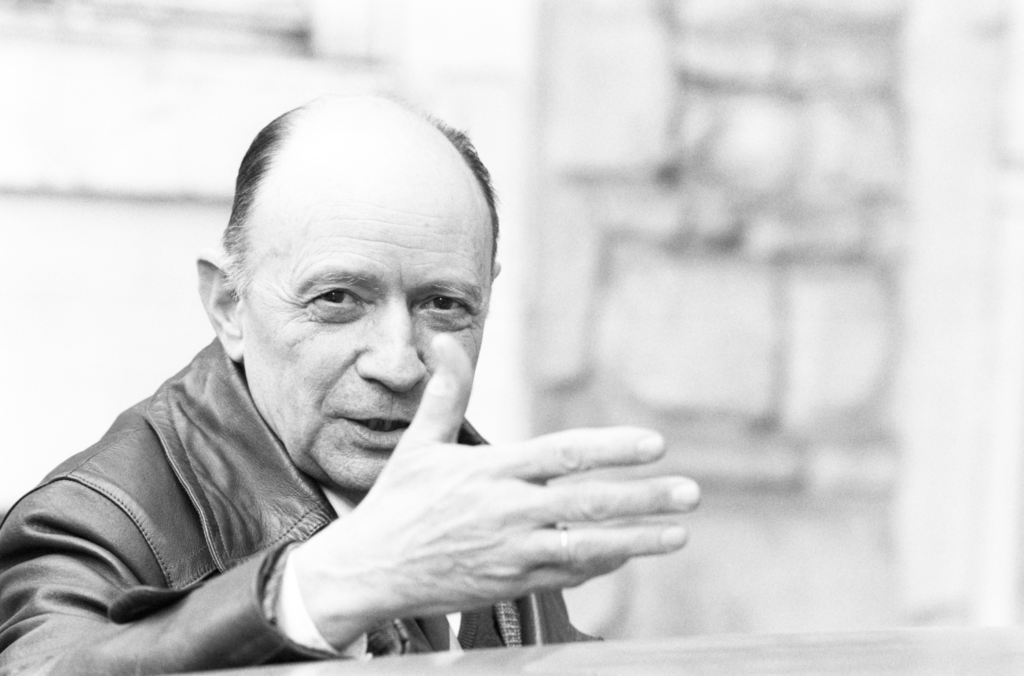
“The essential point, according to Ellul, is that technique produces all this without plan; no one wills it or arranges that it be so. Our technical civilization does not result from a Machiavellian scheme. It is a response to the ‘laws of development’ of technique. In proposing and expanding this thesis, Ellul reopens the great debate over the social, political, economic, and philosophical meaning of technique in the modern age. We need not agree with Ellul to learn from him. He has given us a provocative book, in the sense that he has provoked us to re-examine our assumptions and to search out the flaws in his own gloomy forecasts. By doing so, he helps us to see beyond the banal assertion that ours has become a mass society, and he leads us to a greater understanding of that society.” (Source: Ibid. p. viii)
“Our erstwhile means have all become an end, an end, furthermore, which has nothing human in it and to which we must accommodate ourselves as best we may. We cannot even any longer pretend to act as though the ends justified the means, which would still be recognizably human, if not particularly virtuous. Technique, as the universal and autonomous technical fad, is revealed as the technological society itself in which man is but a single tightly integrated and articulated component. The Technological society is a description of the way in which an autonomous technology is in process of taking over the traditional values of every society without exception, subverting and suppressing these values to produce at last a monolithic world culture in which all non-technological difference and variety is mere appearance.” (Source: Ibid. p. x)
Later in the book Ellul lists the areas where humans are shaped by Technique:
“Human Tension
Never before has so much been required of the human being. By chance, in the course of history some men have had to perform crushing labors or expose themselves to mortal peril. But those men were slaves or warriors. Never before has the human race as a whole had to exert such efforts in its daily labors as it does today as a result of its absorption into the monstrous technical mechanism – an undifferentiated but complex mechanism which makes it impossible to turn a wheel without the sustained, persevering, and intensive labor of millions of workers, whether in white collars or in blue. The tempo of man’s work is not the traditional, ancestral tempo; nor is its aim the handiwork which man produced with pride, the handiwork in which he contemplated and recognized himself.” (Source: Ibid. pp. 319-320)
“Modification of the Milieu and Space
Technique has penetrated the deepest recesses of the human being. The machine tends not only to create a new human environment, but also to modify man’s very essence. The milieu in which he lives is no longer his. He must adapt himself, as though the world were new, to a universe for which he was not created. He was made to go six kilometers an hour, and he goes a thousand. He was made to eat when he was hungry and to sleep when he was sleepy; instead, he obeys a clock. He was made to have contact with living things, and he lives in a world of stone. He was created with a certain essential unity, and he is fragmented by all the forces of the modern world.
Admittedly, the machine has enriched man as it has changed him. The machine’s senses and organs have multiplied the powers of human senses and organs, enabling man to penetrate a new milieu and revealing to him unknown sights, liberties, and servitudes. He has been liberated little by little from physical constraints, but he is all the more the slave of abstract ones. He acts through intermediaries and consequently has lost contact with reality.” (Source: Ibid. p. 325)
“The Creation of the Mass Society
There is a third area in which human techniques are applied, and it represents a further cause of disequilibration for the human being seeking to adapt to his new milieu.
It is a truism to state that contemporary society is becoming a mass society. The ‘process of massification,’ ‘the accession of the masses’ have been thoroughly studied and understood. Less well understood, however, is the fact that the man of the present is not spontaneously adapted to the new form of society. Previous societies took their character to a very large degree from the men in them. Technical or economic conditions imposed certain sociological structures, but the human being was in essential agreement with these structures, and the form society took expressed the psychology of the individual. This is no longer true. The process of massification takes place not because the man of today is by nature a mass man, but for technical reasons.” (Source: Ibid. p. 332)
“Human Techniques
It thus became imperative to rethink the whole situation of man in his new world. But thinking things through seemed altogether insufficient; it was necessary to act. Action upon the techniques themselves appeared to be impossible.
The question therefore became: Is it not possible to act upon man himself? To help him resist? To protect him, perhaps; to educate him, certainly? The applications of the human sciences were worked out along these lines of thought.” (Source: Ibid. p. 335)
“Educational Technique
Progressive education has as its end the ‘happiness’ of the child. It entails bright classrooms, understanding teachers, and pleasurable work. Its educational formulas are well-known: the child in school must be ‘relaxed’ and enjoy himself; he must exist in a ‘balanced environment,’ get rid of his ‘complexes,’ and ‘play while he is learning’. All this represents a perfectly valid program.
It has the elements of genial scholarship derived from the celebrated saying of Montaigne to the effect that we must stop cramming children’s skulls to pass the baccalaureate; supercharging their brains with encyclopedic knowledge to the detriment of all other activities. Education must seek, rather, to develop in a balanced way all their faculties, physical, manual, psychic, and intellectual, and in this last, it must seek to stress personal observation and reasoning instead of rote learning. Moreover, the whole process is supposed to take place with the minimum possible use of force. It is essential to respect the person of the child and to individualize instruction to the maximum. Instruction is part of total education and is not addressed to the intelligence alone. Its method, based on the maieutic of Socrates, consists in bringing the child himself to discover the properties of objects or, starting from facts he himself observes, the principles which underlie them.
This educational procedure is, however, a highly refined technique, detailed and rigorous; and it makes the most exacting demands on the technician himself, who must indeed be a remarkable pedagogue to be able to apply it. It is not a mechanical technique that applies itself almost ipso facto. The same holds for the majority of the human techniques we shall discuss. The person of the technician counts for a very great deal.” (Source: Ibid. p. 345)
“Propaganda
The prime consideration is the union of two very different categories of technique which yield this new system of human technique. The first is a complex of mechanical techniques (principally radio, press, and motion pictures) which permit direct communication with a very large number of persons collectively, while simultaneously addressing each individual in the group. These techniques possess an extraordinary power of persuasion and a remarkable capacity to bring psychic and intellectual pressure to bear. The second category consists of a complex of psychological (and even psychoanalytical) techniques which give access to exact knowledge of the human psyche. It can thus be motivated with considerable confidence in the results.” (Source: Ibid. p. 363)
“L’homme-machine
A progressively more complete technical knowledge of man is being developed. Will it liberate him? Man’s traditional, spontaneous activities are now subjected to analysis in all their aspects–objects, modes, durations, quantities, results. The totality of these actions and feelings is then systematized, schematized, and tabulated. A human type is created which is the only recognizable ‘normal’.” (Source: Ibid. p. 395)
I conclude this essay with the following words from The Technological Society:
“Technical Anesthesia. It seems odd that the application of a technique designed to liberate men from the machine should end in subjecting them the more harshly to it.”
Link for downloading a copy of Ellul’s The Technological Society free of charge for personal reading: https://voidnetwork.gr/wp-content/uploads/2021/09/The-Technological-Society-Jacques-Ellul.pdf
All content on this website is copyrighted, and cannot be republished or reproduced without permission.
Share this article!




The truth does not fear investigation.
You can help support Dominion Review!
Dominion Review is entirely funded by readers. I am proud to publish hard-hitting columns and in-depth journalism with no paywall, no government grants, and no deference to political correctness and prevailing orthodoxies. If you appreciate this publication and want to help it grow and provide novel and dissenting perspectives to more Canadians, consider subscribing on Patreon for $5/month.
- Riley Donovan, editor