
The federal government is deploying two helicopters to Surrey as police forces in BC’s second-largest city struggle to maintain control of the streets.
Surrey’s Indian community has been under siege from a constant barrage of extortion threats, frequently accompanied by arsons and shootings targeted at both homes and businesses. What is now widely being referred to as Surrey’s “extortion crisis” is not the product of homegrown crime, but rather a direct result of Canada’s open-door immigration policy.
The chaotic violence and disorder unfolding in that city is exactly what immigration restrictionists have been warning our political elite about for decades – the Canadian public is now suffering because of the determined refusal of successive governments to heed those warnings.
Open-door immigration has long fuelled the rise of a diverse array of organized crime groups in Canada, from black street gangs to the money laundering Triads. The specific extortion wave now unfolding in Surrey is related to a more recent era of immigration – the astronomic growth of Canada’s temporary resident population in the post-pandemic Trudeau years.
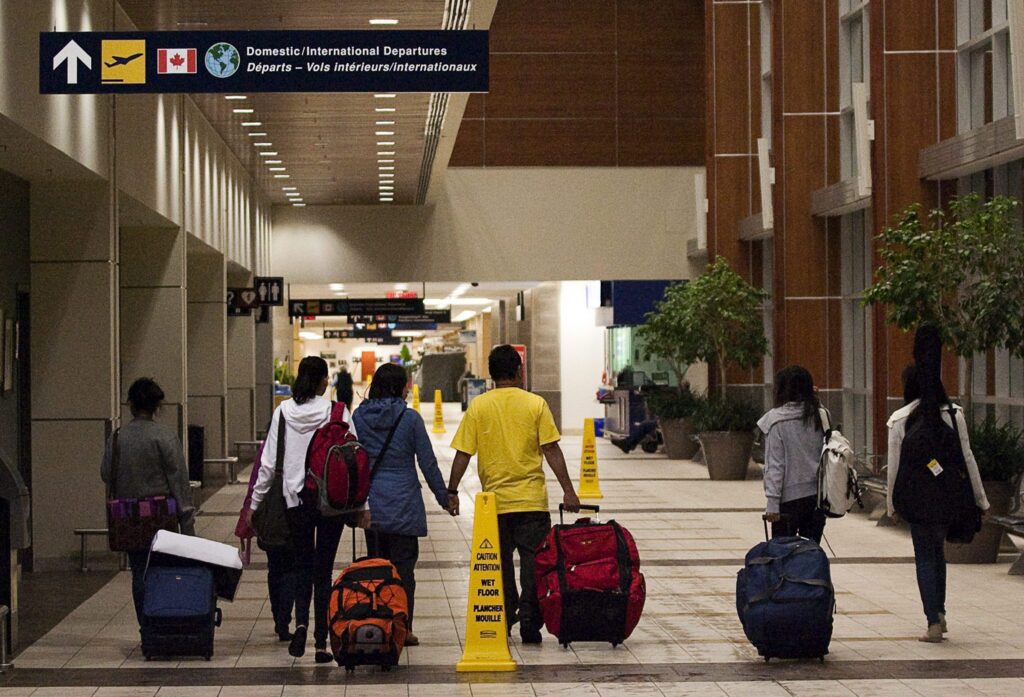
The proportion of Canada’s population made up of temporary residents expanded from 3.3% in 2018 to 7.5% in 2024 – more than three million in all.
The sheer volume of the inflow made scrupulous vetting next to impossible, and a criminal element was able to slip into Canada on study visas and work permits.
According to a report in the Indian press, two of the three Indian nationals arrested in connection with the June 2023 assassination of Sikh separatist Hardeep Singh Nijjar in Surrey came to Canada on study visas, while a third came with a work permit. One of three suspects in the brutal double homicide of an elderly couple in Abbotsford in 2022 had come on a study visa less than a month before the killings.
It appears to be the case that while a hardcore criminal element did infiltrate the country on study visas or work permits with the intention of committing crime (similar to the South American “crime tourist” gangs who fly into Canada on visitor visas to burgle houses), others are being recruited after their arrival, or after their visas expire. This is a concern that I highlighted in an October 2024 article after the Trudeau government reversed course on immigration and capped temporary resident numbers:
“…Canada will have to deal with an increased population of illegal immigrants on our soil (we already have somewhere between 300,000 and 600,000). Poor, desperate, probably resentful, with non-existent or fake documents, this population will be a thorn in Canada’s side. Locked out of most employment, some may turn to petty or organized crime.”
The stratospheric expansion of temporary residents after the pandemic, many of whom came to Canada on the understanding that they would receive permanent residency, has created a substantial pool of visa overstayers from which gangs can draw upon.
One alleged extortionist accused of torching Punjabi musician AP Dhillon’s vehicles and firing into his Vancouver Island home in 2024 was reported to have been living in Canada on an expired study visa. As the Surrey extortion crisis has ramped up this year, reports of extortion-related violence have habitually been accompanied by a description of the perpetrators as “foreign nationals” – though we are not always told whether the individuals are international students, foreign workers, or visa overstayers.


The Surrey Police’s account of a recent roundup of suspects provides a glimpse into the chaos that has been unleashed onto Surrey’s streets, with three suspects attempting to flee the scene of a crime in a “rideshare vehicle”.
“On February 1, 2026, at approximately 3:50 am, Surrey Police Service (SPS) members assigned to Project Assurance, working in collaboration with SPS’s Major Crime Section, were patrolling in Surrey’s Crescent Beach neighbourhood when reports came in of shots fired and a small fire outside a residence near Crescent Road and 132 Street. The three accused were arrested by SPS officers a short time later near 28 Avenue and 140 Street after getting into a rideshare vehicle…
SPS has confirmed they are all foreign nationals [emphasis mine] and has engaged Canada Border Services Agency.”

An article in Surrey Now-Leader describes a similar incident, also involving individuals described as “foreign nationals”, which also occurred this year:
“Two foreign nationals have been charged in connection with an alleged early morning shooting on Monday in Newton. Harshdeep Singh, 20, and Hanspreet Singh, 21, have been charged with ‘occupying a vehicle knowing a firearm is present.’ Harshdeep is also charged with one count of dangerous operation of a motor vehicle”.
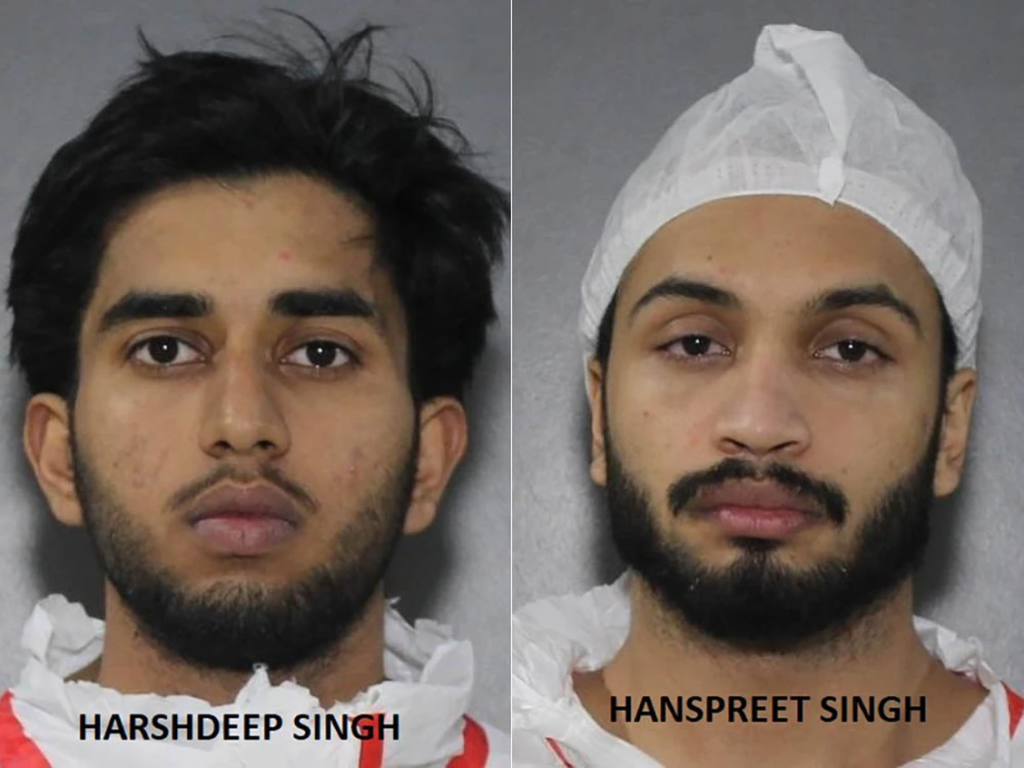
In December, it was reported that 15 extortion suspects had claimed asylum. This week, Premier David Eby called the fact that extortionists are able to claim asylum “ludicrous” and said that Bill C-12, the Carney government’s Strengthening Canada’s Immigration System and Borders Act, will close that loophole.
The extortion crisis in Surrey has begun to take on a truly anarchic character, with a report circulating last month that people in one residence returned fire on extortionists outside their home. One Surrey resident issued a letter to Premier Eby calling for the province to expedite the issuance of 500 gun licences so that citizens can arm up and defend themselves against the gangsters. The resident, Vikram Bajwa, told media: “I strongly believe we have to become B.C. vigilante cowboys in order to respond to this violence”.
Canada has long prided itself on the limited need for vigilantism in this country as compared to the United States. Whereas the American West was characterized by sporadic violence, posses, lynchings, and duels, the settlement of the Canadian West was a more orderly affair overseen by the steady hand of the North-West Mounted Police – the predecessor of the RCMP.
Our forebears carved out of the northern half of this continent a quiet Dominion with an ethos of “peace, order, and good government”. This motto did reflect the reality of Canada at one point, but was contingent on strong borders to screen out criminal elements from abroad. There are now parts of the country in which law and order no longer prevails, in which gangsters pull up to a house in the early hours and open fire, only for the residents to take out their own guns and shoot back.
A comparable situation has been playing out for some time in Western Europe, with the proliferation of so-called “no-go zones” – immigrant enclaves where the power of gangs has effectively displaced that of the police. Once dismissed as a conspiracy theory or urban legend, it is now widely acknowledged that travellers to cities like Paris should avoid certain immigrant enclaves even in broad daylight, just as the locals do.
The deterioration of law and order in Surrey is once again highlighting the disruptive effect of unchecked immigration, and comes as Canadian favourability towards immigration reaches a new record low:
“Only a third of Canadians currently hold favourable views on immigration, a new Research Co. poll has found.
In the online survey of a representative national sample, 34% of Canadians think immigration is having a mostly positive effect in Canada, down nine points since a similar Research Co. poll conducted in July 2025.
Almost half of Canadians (48%, +9) say immigration is having a mostly negative effect in the country.”
All content on this website is copyrighted, and cannot be republished or reproduced without permission.
Share this article!


The truth does not fear investigation.
You can help support Dominion Review!
Dominion Review is entirely funded by readers. I am proud to publish hard-hitting columns and in-depth journalism with no paywall, no government grants, and no deference to political correctness and prevailing orthodoxies. If you appreciate this publication and want to help it grow and provide novel and dissenting perspectives to more Canadians, consider subscribing on Patreon for $5/month.
- Riley Donovan, editor