Over the past 18 months or so, there has emerged an identitarian term within certain spheres of the Canadian Right – namely, from the leadership of the Dominion Society – that seeks to unify the descendants of founding and settler populations under a single banner. This term is ‘Heritage Canadian’, and although I believe it remains relatively ill-defined, there exists potential for the identity to become increasingly coherent and powerful in the years to come.
You see, cultures throughout history have morphed, evolved, and transformed in the way they self-identify, in how they conceive of themselves. Many historians, such as Oswald Spengler, Arnold Toynbee, and (in his own way) our very own Harold Innis, have understood such identitarian evolution as a cyclical process, arguing that elements of every culture transform over time and give way to new forms and self-understandings. Groups such as the Han Chinese and Mizrahi Jews, who have maintained remarkable continuity in language, ritual, custom, mythology, and genetics over millennia, are the cultural exception, rather than the rule.
If we, for the purposes of this thought experiment, aimed to uncover a hidden benefit of Canada’s post-war, multi-cultural policy, then there could be discovered, hidden radically in subterranean obscurity, a mandate to accelerate ethno-cultural genesis, and re-imagine our identity.
The Birth Of English Canada
To help elucidate what the hell I mean by this, it is first necessary to perform a cursory review of cultural development on the North American continent. For a century and a half, the empires of France and England competed for dominance, before the latter – reconstituted (or, re-imagined) as the British – triumphed in the Seven Years War, acquiring important sections of French territory as part of the Treaty of Paris. By this time, the English speaking peoples in the Americas, primarily settled near the Atlantic coast, had undergone immense cultural evolution internally, and diverged in religious, economic, and social custom and tradition, leading to numerous fractures and divides that eventually culminated in the US Civil War.
Another divergence within English civilization followed the conclusion of the Revolutionary War, when colonists loyal to the Crown migrated north and settled the relatively under-developed territory still under British rule. We know this history well. It is the Birth of English Canada. But, who were these settlers? From the moment the Union Jack first flew along the shores of the Niagara River, these lands were populated by several old-world cultural groups aligned with the crown, most prominently English Anglicans, Scottish Presbyterians, Ulster-Irish, German Lutherans and Mennonites, and the Iroquois. Our opponents are correct in their assertion that, historically, there is no unified ‘Heritage Canadian’ identity.

A New World
However, due to three overarching factors acting throughout the last century, we may, as bold Canadian Nationalists, be able to construct, build, and assert the existence of such an identity, and defend our continued existence as such. Let us examine the following three macro-level developments:
- Rapid increase in inter-ethnic marriage between old-world European groups, radically altering how offspring identified.
- Mass migration and demographic change, which has/will balkanize the population into large, competitive ethnic blocs.
- Modern technology, which has standardized the way we live and work on a day-to-day basis, altering the tradition and way of life of specific old-world cultures (this will not be expanded on in this article, but a reading of George Grant’s ‘Technology and Empire’ serves as the bedrock of this assertion).
Within the Government of Canada’s 1941 census, there is a section titled ‘Ethnic Origin and Nativity of the Canadian People’. “Since the beginning of the century”, the introduction reads, “the composition of the population of Canada has been in a state of rapid change”. Not only had the population originating from the British Isles declined, but the rate of inter-marriage between them and those of other European origins grew substantially. “Speaking generally, the decade 1931-1941 witnessed a remarkable increase in the amount of intermarriage between non-British and non-French origins on the one hand and the two basic elements of the population on the other”, listing the percentage of married males of north-western European descent who married outside their origin at 52.3% in 1941, compared to around 38% in 1931.
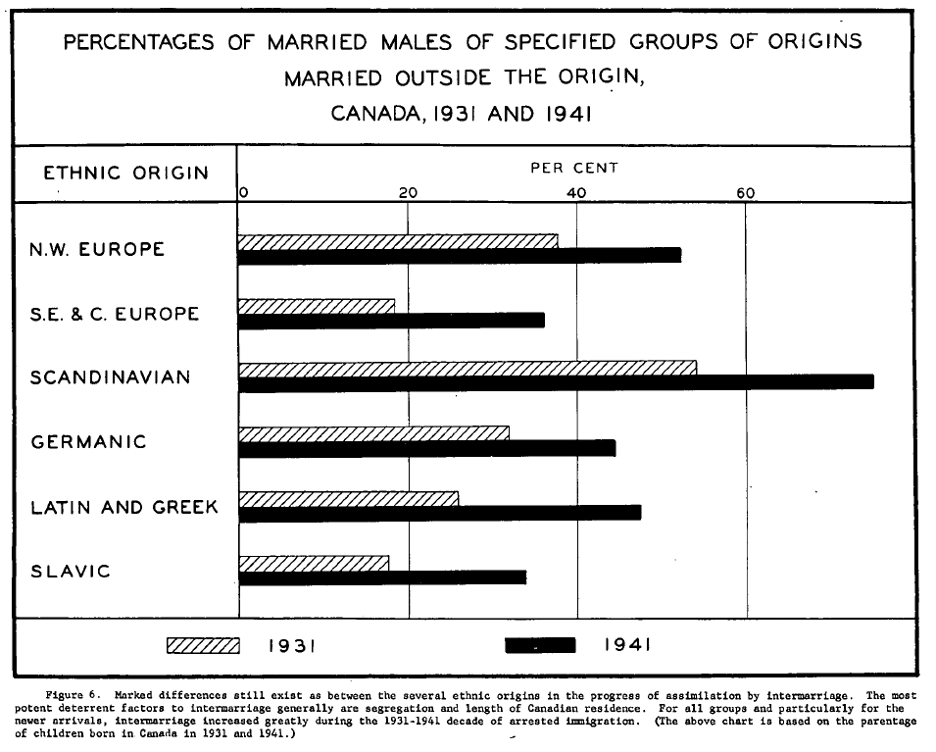
One can imagine this trend increasing steadily throughout the 20th century (we are forced to imagine, since detailed studies in ethnic origin like this became much less common after WW2). The result here was not just the assimilation of other European groups, but a revolution in identity. Like other instances of ethno-genesis throughout history, mass inter-marriage had the effect of diluting memory and connection to any particular ethno-cultural origin. Ardent defenders of Canada’s British character and the symbols thereof slowly declined in vitality and vigour. While French Canada’s demographics remained comparatively stable (changing to a greater extent religiously with the quiet revolution than ethnically), English Canada underwent a transformation.
Opportunity And Sacrifice
Arising from what could be viewed as destructive transformation, lies potential for great opportunity. A very large number of us have ancestry that is predominantly north-western European, but of a messy and confusing confluence of components. To put it in a derogatory way – we are mutts. There are Welsh, Lowland Scotts, Ulster Irish, Georgies, and Anglo-Normans, each with their own branch on my family tree. A friend of mine calls herself a “British Isles Special”. What I am trying to impart is that there is no dominant old-world identity for many English Canadians to fall back on. In this context, ‘Heritage Canadian’ is not only a useful signifier, but a banner under which we can bind together in an otherwise barren and outdated cultural space.
To achieve the level of ethno-cultural synthesis that is required to make the term ‘Heritage Canadian’ coherent, there requires great sacrifice. Fierce partisan loyalties and grudges – Catholic vs Protestant, English vs Gaelic, Eastern vs Western Canadian – will need to be subdued in our identity salience hierarchy. Just as in England there are local identities that fall within the overarching national and ethnic conception of the ‘English’, so too would there be subsets within the term ‘Heritage Canadian’.
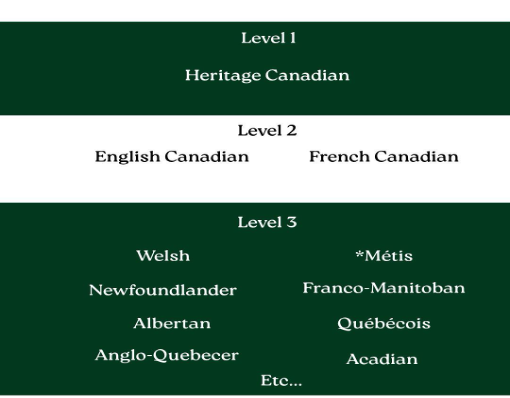
[Here is an attempt to construct an ethnic identity salience hierarchy centred around ‘Heritage Canadian’. Many people, like myself, are a mix of several level 3 identities, and therefore fall back on a broader level 1 or 2 conception of self. On a side note, there ought to be a term for someone who descends from many prominent northwestern European cultures over the past 1500 years, such as the Normans, Anglo-Saxons, Vikings, Scottish and Irish Gaels, Brittons, Dutch, etc.]
*the Metis are a special case, and they may prefer not to identify as a Heritage Canadian.
Although the desire to construct a coherent ethno-cultural identity out of the remnants of Canada’s historical development is in part due to the dissolution of old-world conceptions, possibly of greater importance is a sense of urgency caused by external pressure.
The last-half century has witnessed a demographic upheaval within traditionally European countries, as waves of mass migrations from comparatively over-populated regions of the world have entered and settled. Again – we know this history well. What is important to understand here is that various groups entering the country possess their own identity salience hierarchies, and will increasingly be able to assert collective influence as their pool of the population grows in size. Eventually, this will result in a form of pluralism devoid of a clear dominant, majority group.
As these blocs emerge, it is vital that those under the ‘Heritage Canadian’ banner are politically unified enough to construct an agenda of collective interest. If we were to imagine such policies/actions, examples range from – increasing domestic birth rates, supporting core industries (mining, forestry, energy), training domestic workers in high skilled jobs, preservation of traditional symbols, firearm rights, and under the right circumstances, CANZUK.
Of course, the current state of affairs is practically the opposite of the imagined reality constructed above. ‘Heritage Canadians’ are divided on the grounds of gender, generation, religion, and education level, with very little sign of solidarity. The identity remains aspirational, lacking the institutions, leadership, and self-understanding necessary to give it any real power. Though the logs have been cut and the kindling laid, the flames of fire are yet to have caught. The mission of our generation, then, is to build, construct, and resurrect pillars of cultural success.
Without such a movement, we will be left atomized within a society of rival tribalisms. Perhaps the right term is not ‘Heritage Canadian’. But regardless of what we call ourselves, English Canada needs a banner to collectively rally around, a symbol that represents our ethno-cultural experience, an identity that helps us understand ourselves as a unified, coherent people. The Dominion Society’s conception of ‘Heritage Canadian’ is but the first attempt to undertake such a mission in the post-WW2 era.
All content on this website is copyrighted, and cannot be republished or reproduced without permission.
Share this article!

The truth does not fear investigation.
You can help support Dominion Review!
Dominion Review is entirely funded by readers. I am proud to publish hard-hitting columns and in-depth journalism with no paywall, no government grants, and no deference to political correctness and prevailing orthodoxies. If you appreciate this publication and want to help it grow and provide novel and dissenting perspectives to more Canadians, consider subscribing on Patreon for $5/month.
- Riley Donovan, editor