
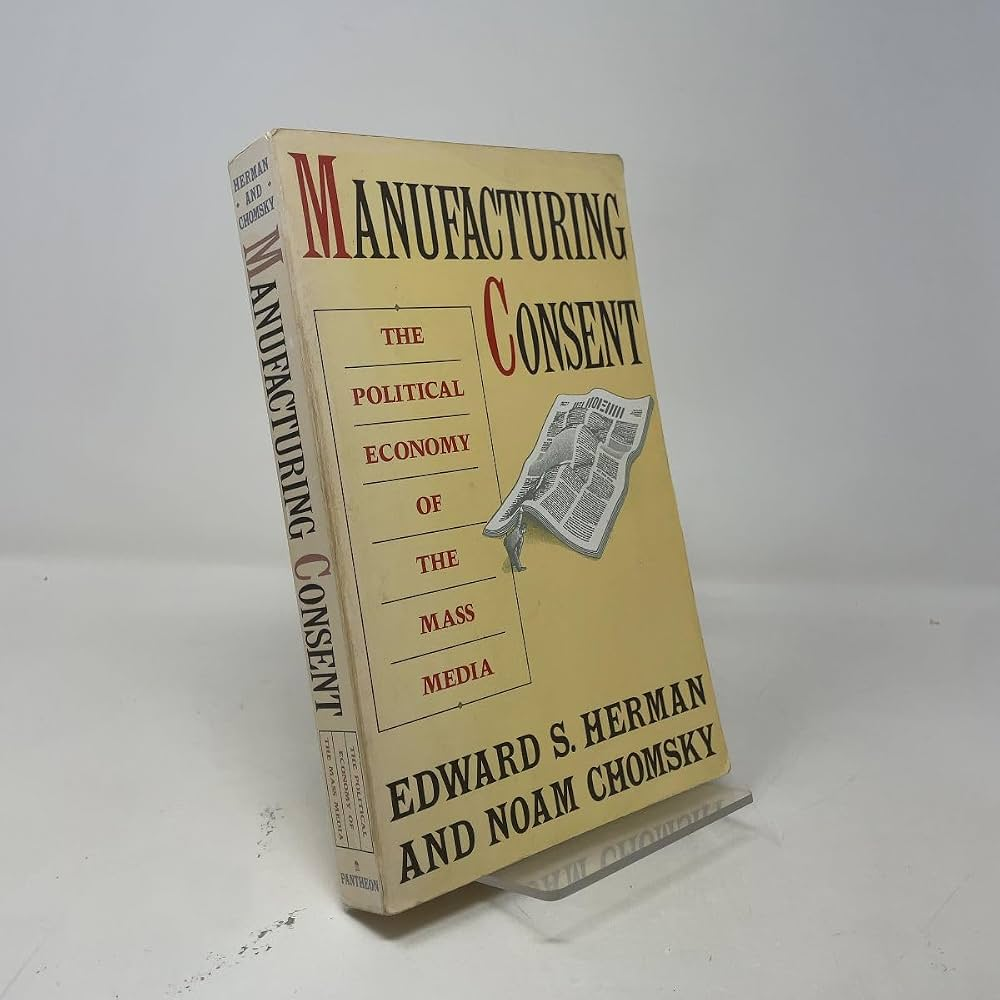
Democracies, we are told, are governed with the consent of the people who constitute the sovereign power in modern democracies. This is merely an illusion. As Professors Noam Chomsky and Edward Herman document the processes governing modern democracies in their monumental work, Manufacturing Consent, deception and modern propaganda totally shape public opinion and lead citizens of democracies to action or inaction as the ruling elites desire.
The following are selections from their work:
_________________________________________________________________________
“They who have put out the people’s eyes, reproach them of their blindness.” John Milton
_________________________________________________________________________
“The mass media serve as a system for communicating messages and symbols to the general populace. It is their function to amuse, entertain, and inform, and to inculcate individuals with the values, beliefs, and codes of behavior that will integrate them into the institutional structures of the larger society. In a world of concentrated wealth and major conflicts of class interest, to fulfil this role requires systematic propaganda.
In countries where the levers of power are in the hands of a state bureaucracy, the monopolistic control over the media, often supplemented by official censorship, makes it clear that the media serve the ends of dominant elite. It is much more difficult to see a propaganda system at work where the media are private and formal censorship is absent. This is especially true where the media actively compete, periodically attack and expose corporate and governmental malfeasance, and aggressively portray themselves as spokesmen for free speech and the general community interest. What is not evident (and remains undiscussed in the media) is the limited nature of such critiques, as well as the huge inequality in command of resources, and its effect both on access to a private media system and on its behavior and performance.” (Source: Manufacturing Consent, p. 61)
“This book centers in what we call a ‘Propaganda model,’ an analytical framework that attempts to explain the performance of the […..] media in terms of the basic institutional structures and relationships within which they operate. It is our view that, among their other functions, the media serve, and propagandize on behalf of, the powerful societal interests that control and finance them. The representatives of these interests have important agendas and principles that they want to advance, and they are well positioned to shape and constrain media policy. This is normally not accomplished by crude intervention, but by the selection of right-thinking personnel and by the editors’ and working journalists’ internalization of priorities and definitions of newsworthiness that conform to the institution’s policy.” (Source: Ibid., p. 12)

“Structural factors are those such as ownership and control, dependence on other major funding sources (notably, advertisers), and mutual interests and relationships between the media and those who make the news and have the power to define it and explain what it means. The propaganda model also incorporates other closely related factors such as the ability to complain about the media’s treatment of news (that is, produce ‘flak’), to provide ‘experts’ to confirm the official slant on the news, and to fix the basic principles and ideologies that are taken for granted by media personnel and the elite, but are often resisted by the general population. In our view, the same underlying power sources that own the media and fund them as advertisers, that serve as primary definers of the news, and that produce flak and proper-thinking experts, also play a key role in fixing basic principles and the dominant ideologies. We believe that what journalists do, what they see as newsworthy, and what they take for granted as premises of their work are frequently well explained by the incentives, pressures, and constraints incorporated into such a structural analysis.” (Source: Ibid., p. 12)
At this point we pass over the authors’ further explanation of the propaganda model and select practical examples of how consent is manufactured in modern democracies:
“In the 1983 Turkish election, held under military rule, with harsh censorship and only three parties ‘led by politicians sympathetic to the military government’ allowed to run, the Times found that ‘Turkey Approaches Democracy.’ Similarly, in Uruguay’s 1984 election, under another military regime that jailed the leading opposition candidate and also refused to allow a second major candidate to run, but organized by a government approved by the U.S. State Department, the Times once again found that ‘Uruguay is resuming its democratic vocation . . . the generals are yielding to the infectious resurgence of democracy in much of Latin America.'” (Source: Ibid., p. 28)
“The Russian election of 1996 was important to the United States and its allies, as Boris Yeltsin, the ruler who was carrying out their favored policies of privatization and the integration of Russia into the global financial system, was seriously threatened with defeat. The Yeltsin government had presided over a 50 percent fall in national output and large income declines for 90 percent of the population, while the hugely corrupt privatization process provided windfalls to a small minority, including an important criminal class. The social welfare and health care systems had disintegrated under Yeltsin’s rule, contributing to a startling rise in infectious diseases and mortality rates. Just before the 1996 election campaign, Yeltsin’s popularity rating was 8 percent. That he could win re-election in such circumstances suggests – and reflects – a seriously flawed election. However, with the Yeltsin regime strongly backed by the U.S. government and its Western allies, the New York Times once again found this election ‘A Victory for Russian Democracy,‘ and so did the U.S. mainstream media in general.” (Source: Ibid., p. 29)
“In the health insurance controversy of 1992–93, the media’s refusal to take the single-payer option seriously, despite apparent widespread public support and the effectiveness of the system in Canada, served well the interests of the insurance and medical service complex. The uncritical media reporting and commentary on the alleged urgency of fiscal restraint and a balanced budget in the years 1992–96 fit well the business community’s desire to reduce the social budget and weaken regulation.” (Source: Ibid., p. 53)
“. . . . the negative performance effects of the media result primarily from their structure and objectives, real change in performance calls for substantial changes in underlying media organization and goals. In the years since 1988, structural changes have not been favorable to improved performance, but it remains a central truth that democratic politics requires a democratization of information sources and a more democratic media. Along with trying to contain and reverse the growing centralization of the mainstream media, grassroots movements and intermediate groups that represent large numbers of ordinary citizens should put much more energy and money into creating and supporting their own media – as they did with the Independent Media Centers brought into existence during the Seattle and Washington, D.C., protests of 1999 and 2000. These and other nonprofit community-based broadcasting stations and networks, and a better use of public-access channels, the Internet, and independent print media, will be essential for the achievement of major democratic social and political successes.” (Source: Ibid., p. 54)
“The special importance of propaganda in what Walter Lippmann referred to as the ‘manufacture of consent’ has long been recognized by writers on public opinion, propaganda, and the political requirements of social order. Lippmann himself, writing in the early 1920s, claimed that propaganda had already become ‘a regular organ of popular government,’ and was steadily increasing in sophistication and importance.” (Source: Ibid., p. 55)
“A propaganda model focuses on this inequality of wealth and power and its multilevel effects on mass-media interests and choices. It traces the routes by which money and power are able to filter out the news fit to print, marginalize dissent, and allow the government and dominant private interests to get their messages across to the public. The essential ingredients of our propaganda model, or set of news ‘filters,’ fall under the following headings: (1) the size, concentrated ownership, owner wealth, and profit orientation of the dominant mass-media firms; (2) advertising as the primary income source of the mass media; (3) the reliance of the media on information provided by government, business, and ‘experts’ funded and approved by these primary sources and agents of power; (4) ‘flak’ as a means of disciplining the media; and (5) ‘anticommunism’ as a national religion and control mechanism. These elements interact with and reinforce one another. The raw material of news must pass through successive filters, leaving only the cleansed residue fit to print. They fix the premises of discourse and interpretation, and the definition of what is newsworthy in the first place, and they explain the basis and operations of what amount to propaganda campaigns.” (Source: Ibid., pp. 61-62)
“The elite domination of the media and marginalization of dissidents that results from the operation of these filters occurs so naturally that media news people, frequently operating with complete integrity and goodwill, are able to convince themselves that they choose and interpret the news ‘objectively’ and on the basis of professional news values. Within the limits of the filter constraints they often are objective; the constraints are so powerful, and are built into the system in such a fundamental way, that alternative bases of news choices are hardly imaginable.” (Source: Ibid., p. 62)
“We do not accept the view that freedom of expression must be defended in instrumental terms, by virtue of its contribution to some higher good; rather, it is a value in itself. But that apart, these ringing declarations express valid aspirations, and beyond that, they surely express the self-image of the American media. Our concern in this book has been to inquire into the relation between this image and the reality. In contrast to the standard conception of the media as cantankerous, obstinate, and ubiquitous in their search for truth and their independence of authority, we have spelled out and applied a propaganda model that indeed sees the media as serving a ‘societal purpose,’ but not that of enabling the public to assert meaningful control over the political process by providing them with the information needed for the intelligent discharge of political responsibilities. On the contrary, a propaganda model suggests that the ‘societal purpose’ of the media is to inculcate and defend the economic, social, and political agenda of privileged groups that dominate the domestic society and the state. The media serve this purpose in many ways: through selection of topics, distribution of concerns, framing of issues, filtering of information, emphasis and tone, and by keeping debate within the bounds of acceptable premises. We have sought to show that the expectations of this model are realized, and often considerably surpassed, in the actual practice of the media in a range of crucial cases. We quite agree with Chief Justice Hughes, whom Lewis also cites, on ‘the primary need of a vigilant and courageous press’ if democratic processes are to function in a meaningful way. But the evidence we have reviewed indicates that this need is not met or even weakly approximated in actual practice.” (Source: Ibid., p. 373)
“As noted by media analyst W. Lance Bennett, ‘The public is exposed to powerful persuasive messages from above and is unable to communicate meaningfully through the media in response to these messages . . . Leaders have usurped enormous amounts of political power and reduced popular control over the political system by using the media to generate support, compliance, and just plain confusion among the public'”. (Source: Ibid., p. 378)
“There are other considerations that tend to induce obedience. A journalist or commentator who does not want to have to work too hard can survive, even gain respectability, by publishing information (official or leaks) from standard sources; these opportunities may well be denied to those who are not content to relay the constructions of state propaganda as fact.” (Source: Ibid., p. 381)
“In sum, the mass media of the United States [and Canada] are effective and powerful ideological institutions that carry out a system-supportive propaganda function by reliance on market forces, internalized assumptions, and self-censorship, and without significant overt coercion. This propaganda system has become even more efficient in recent decades with the rise of the national television networks, greater mass media concentration, right-wing pressures on public radio and television, and the growth in scope and sophistication of public relations and news management.” (Source: Ibid., p. 381)
“Local nonprofit radio and television stations also provide an opportunity for direct media access that has been underutilized in the United States [and Canada]. In France, many local groups have their own radio stations. In a notable case, the progressive cooperative Longo Mai, in Upper Provence, has its own 24-hour-a-day Radio Zinzine, which has become an important community institution that has helped inform and activate many previously isolated farmers. The potential value of noncommercial radio can be perceived in sections of the country where stations such as Pacifica Radio offer a view of the world, depth of coverage, and scope of discussion and debate that is generally excluded from the major media.” (Source: Ibid., p. 383)
“The high gullibility level in reporting the official claims [about WMD in Iraq], without verification or presentation of counter-evidence, is a hallmark of propaganda service. In one notable case, the New York Times placed an article by Judith Miller on its front page that passed along claims of Iraqi WMD by an alleged Iraqi scientist whom Miller hadn’t even spoken to but was allowed to see at a distance; the actual information was provided to Miller by U.S. officials” (Source: Ibid., p. 387)
Link for downloading one copy of Manufacturing Consent free of charge for personal reading: https://files.libcom.org/files/2022-04/manufacturing_consent.pdf
All content on this website is copyrighted, and cannot be republished or reproduced without permission.
Share this article!


The truth does not fear investigation.
You can help support Dominion Review!
Dominion Review is entirely funded by readers. I am proud to publish hard-hitting columns and in-depth journalism with no paywall, no government grants, and no deference to political correctness and prevailing orthodoxies. If you appreciate this publication and want to help it grow and provide novel and dissenting perspectives to more Canadians, consider subscribing on Patreon for $5/month.
- Riley Donovan, editor