
I am not on the political right, which has an obsession with the evils of high government spending and in particular, with running deficits. But the Carney government seems like it is promising to spend massive amounts of money on questionable projects at the same time as it has been cutting back on things that make money – or taxes, like the Carbon Tax and the Digital Services Tax.
Privatizing airports is about the only policy that would raise money, but then the government is promising that passengers will not see any difference for the worse. It cannot be that this scheme will both generate more money for Ottawa and that flyers will not pay more.
Carney had promised to double housing construction, which would mean an increase from 250,000 units per year to roughly 500,000 units per year, which would mean housing for over 1 million people a year when net immigration is now near zero and apartment vacancy rates have skyrocketed.
Thankfully, that plan to double new housing has now been dropped.
Carney was also quick to please Donald Trump by promising defence spending of 5% of GDP, but most spending on defence is wasted unless Canada goes to war or gives weapons to nations that we support who are at war, like Ukraine. And seriously, do we expect Russia or China to land on Ellesmere Island and claim it as theirs?
An expensive project that might seem more practical is the Alto High-Speed Rail (HSR) project that will run from Toronto to Quebec City. Frankly, the fact that it will not run west of Toronto to Mississauga, Hamilton, or Kitchener/Waterloo seems like a mistake, given the high population west of Highway 427 to London.

Now, for years I went to Liberal Party policy conventions in Ontario, and inevitably the top 10 prioritized resolutions would include high speed rail. Progressives look longingly at the extensive rail networks of Europe and Japan. Meanwhile, the car, the suburbs, and so on are unfashionable. It is often unclear why we want or need high speed rail, or who benefits.
Like bike lanes, high speed rail is an obsession with progressive politicians and some voters who are progressive or left of centre, and who are conducting a war on the car, but HSR is also touted as reducing GHGs and cutting travel times. However, the Alto project will not likely be a new version of the “National Dream” of the transcontinental railroad, except that that project was in some ways a boondoggle or massive giveaway to private investors.
Currently, a train trip from Toronto to Montreal takes five to six hours, assuming no delays. Alto promises to cut this time in half, to around three hours. This sounds great, except that flying from Toronto to Montreal takes about one hour and twenty minutes in the air (though passengers are asked to arrive 90 minutes or more before takeoff, which seems nuts). That said, right now a person can fly to Montreal in under three hours all in. Of course, a lot of that time will be spend sitting and waiting, and this time could be shortened particularly at a small airport like Billy Bishop if there were more people paid to speed it up.
Of course, flying is airport to airport, whereas the train is Downtown to Downtown, but not everybody wants to go Downtown, unless perhaps you work in government, for a law firm, or a corporate head office. But Toronto has that UP train that takes 30 minutes to go from Union to the airport, and Montreal is also getting a fast rail service too.
But does the Alto HSR service make any financial sense? This is where there is a problem. The latest estimated cost range is from $60 billion to $90 billion for the entire Toronto-Ottawa-Montreal-Quebec City line, but what major project comes in on budget these days?
The Parliamentary Budget Office (PBO) did their own analysis and estimates, which concluded the price could be as high as $113 billion, though that is the worst case and their low-end number was around $75 billion.
Let’s just assume the cost is the average, around $75 billion in today’s money.
Money is not free and this is a private-public project. Government can borrow at low interest rates, but equity investors need higher returns. Let’s assume a low 5% rate of return is required. So, $75 billion times 5% equals $3.75 billion profit or return on investment, or equivalent net benefits, to make the project break even.
Assuming 365 days a year, that means just under $10.3 million in profit per day, though of course weekends and holidays will have lower volumes.
The trains will likely run three or four times per hour during peak hours, but will likely shut down at night for maintenance. If we assume 18 hours per day, this is 54 to 72 trains per day – but given off-peak hours and weekends, let’s assume 50 trains per day average.
The trains will seat 690 to 1,250 passengers, averaging 970 people. Assume a 50% average rate of passenger load over the entire line, and we are at around 500 passengers, or 25,000 per day. At 75% capacity this is 37,500 passengers per day.
For context, Pearson Airport serves an estimated 100,000 passengers per day, heading to destinations all over the world. Currently, VIA rail carries 2.1 million passengers per year in the Toronto-Quebec City corridor, or 5,700 per day.
The return on capital of $10.3 million per day works out to $412 per passenger at 25,000 per day, or $274 at 75% capacity, just to recover the construction cost and excluding actual operating costs.
Assume operating costs of $100 per passenger, and that means ticket prices of $375 to over $500 one way (or else we would be over the capacity of the trains).
The current cost of a round-trip ticket just for the Toronto Montreal portion is around $150 for economy class, and $250 for business class, meaning a one-way trip might be half of that. Flying round trip from Toronto to Montreal is around $400, so each actual flight is likely as low as $200. Of course, if someone is buying just a one-way fare, the prices are higher.
Many people also currently drive Toronto to Montreal, Toronto to Ottawa, and Montreal to Quebec City. Gas is cheap, and with plug-in electric vehicles, energy is even cheaper and CO2 emissions low, if climate change is an objective. But anyone driving their own car avoids the costs of renting a car at their destination, or taking taxis or Ubers and so on, and when driverless cars are perfected, at least for use on 400 series highways, travellers might be able to sleep or do other things while being driven.
Advocates of HSR often draw comparisons to Europe. Spain has been an example of a country that has built a vast rail network at reasonable cost. France has excellent service, but the UK’s plans have turned into something of a disaster, with the routes being reduced and costs skyrocketing.
Let’s compare distances of ALTO to the UK and France.
London to Birmingham (my mother’s birthplace in 1923) is about 100 miles. As the crow flies Paris to Marseilles is about 410 miles. Toronto to Montreal is 315, Montreal to Quebec is 145. Toronto to Ottawa is 220 miles, and Ottawa to Toronto is under 105, so Toronto to Montreal via Ottawa is 335 miles, as the crow flies. But we need to remember, airplanes can generally fly straight, ignoring the circling or direction of takeoff and landing.
Here is the map of the current planned or potential routes for ALTO, Toronto to Quebec City. The route in large part was intended to go through areas with low populations and land prices, to save money and since the goal is to only have stops at the most important points.
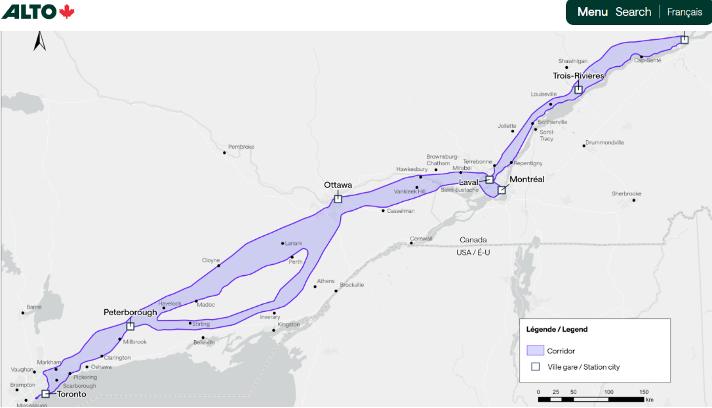
But rather than building a new high speed passenger rail line, a better solution might be to expropriate both the CP and CN main rail lines from Windsor to Quebec City, and then upgrade the CN line to increase speeds, while using the CP line for slower passenger trains and freight trains, with VIA owning the tracks instead of being a nuisance to the corporation that owns the tracks to make money.
It is cheaper and easier to build or upgrade tracks parallel to the current CN and CP main lines to take more freight trains than to build a high-speed rail line for the entire length, from scratch. This would also mean upgraded service in other cities like Kingston, Belleville, Oshawa, and west of Toronto that will not be served at all by the Alto project.
Let’s put the $60 billion to $90 billion current budget in some context. The market capitalization of CN Rail is a good starting point, as it includes the existing Toronto-Quebec City rail lines, which is just a fraction of their assets and business all across Canada and the US. Canadian Pacific Kansas City (CPKC) has a market cap we can also look at for context.
As of early October 2026, approximate figures for the two Class I Canadian railways are below. Market caps move with the share price; debt is from the most recent reported balance sheets (around mid-2026):
Canadian National Railway (CN; TSX: CNR / NYSE: CNI)
- Market capitalization: about CAD 103 billion (roughly USD 72 billion).
- Total debt: about CAD 22.8 billion (roughly USD 16 billion). Cash is only a few hundred million, so net debt is nearly the same as total debt.
Canadian Pacific Kansas City (CPKC, formerly CP Rail; TSX: CP / NYSE: CP)
- Market capitalization: about CAD 108 billion (roughly USD 76 billion).
- Total debt: about CAD 25.2 billion (roughly USD 18 billion). Cash is also only a few hundred million.
So, for CAD 250 billion, we could buy the entire freight operations across North America of both railways, or about CAD 125 billion for either one.
Buying both mainlines from Quebec City to Windsor would likely cost far less than the $113 billion PBO worst case price for a new HSR line, excluding marshalling yards and other things. Here is a map of existing rail lines in the areas in question
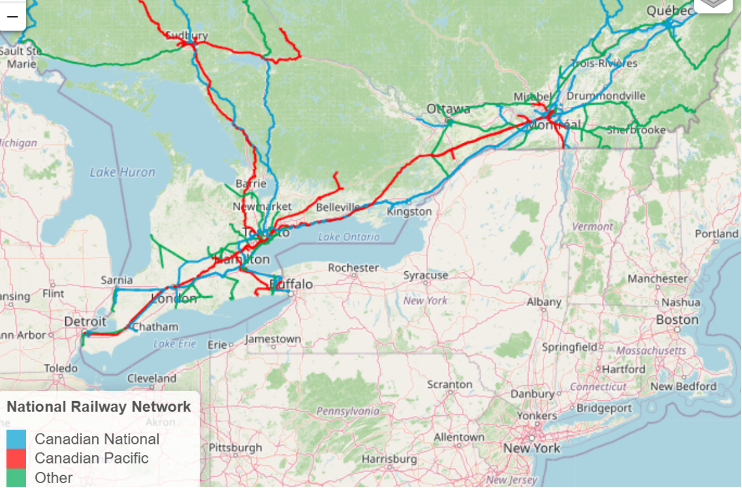
Sir John A. Macdonald is known for the National Dream of the CP rail line to the Pacific, but in fact, the project was a financial nightmare where CP was given a fortune in free land and other benefits including financial guarantees. Some people now think it would have been better off if the government had just fully owned it. Public ownership often makes sense, and even if the Windsor-Quebec City mainlines were expropriated, the government previously owned corporations that were well run, including PetroCanada, C, and – the best example -Polymer Corporation (based in Sarnia).
I doubt that the high-speed rail line as currently proposed makes any financial sense, even if it were to come in on budget. But chances are that the line will not draw the passenger volumes needed at ticket prices that will cover operating costs and the initial capital costs – this risks being a major boondoggle when a more incremental approach of buying up the existing main lines would serve more people, and mean the entire Windsor to Quebec City corridor could be acquired immediately.
Here is a better option, which would allow for improving VIA service as well, which is something the ALTO project cannot do by its route north of Rice Lake and coming into Montreal through the North.
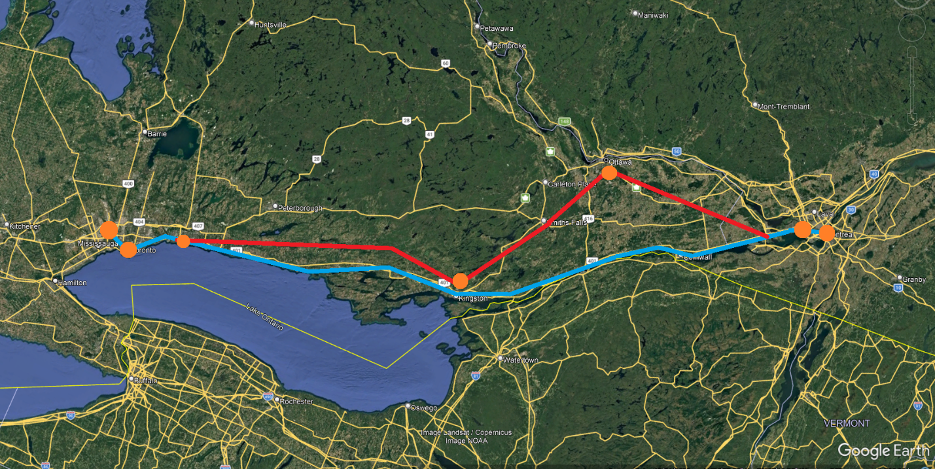
By shifting all or nearly all freight to the CP line (which might require some new freight tracks or rights of way to make it optimal) then the CN tracks from Toronto to Kingston, and from Downtown Montreal to west of the Ottawa River, can be used in areas where creating a new right of way is next to impossible, and the tracks can be upgraded to serve both VIA and ALTO, with transfer points in Dorval, Kingston, and Oshawa.
High speed rail from Toronto to Montreal, or Montreal to Toronto, can be offered once the Montreal-Ottawa and Ottawa-Kingston portions are built – meaning service can start before the Toronto-Kingston (or Toronto-Peterborough-Ottawa line under the current proposal) will be completed – and HSR will not share the tracks with freight trains, only with VIA trains. Even the Toronto-Kingston can be upgraded in increments with a new right of way, or by widening the existing one, from Kingston to Belleville, then Belleville to Oshawa.
Here is a map of the population density:
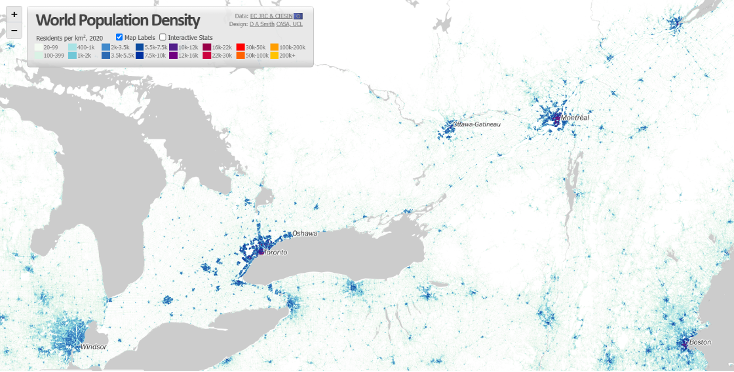
Alto’s current line goes through the least populated areas, north of Rice Lake and with an option that goes south, but seems to have no connections to the current CN/VIA tracks, though the CP tracks do cut north from Belleville to Smith’s Falls.
One question – if something blocks the Alto tracks, does all service stop? By not being close to existing VIA routes on the CN corridor along the lake and river, Alto is not even close enough to the 401 to use buses, yet alone to just reroute the trains around the area where Alto’s tracks are inoperable.
Here is a map of Montreal and environs:
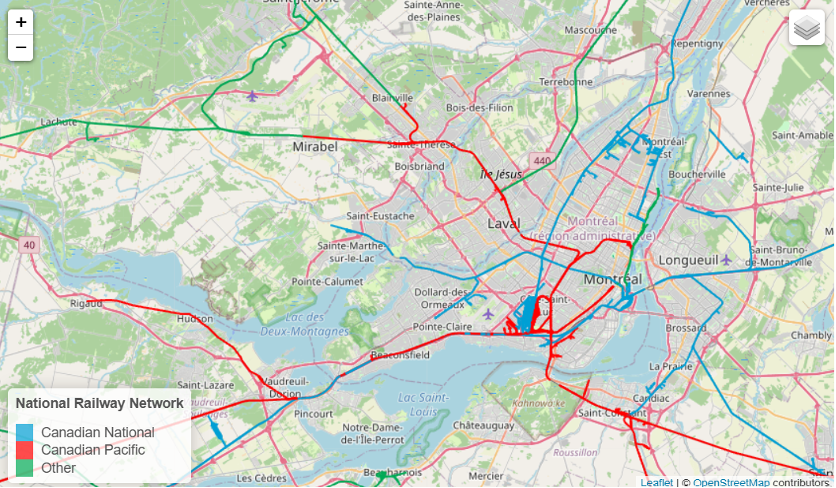
Now, the Montreal-Quebec City portion will likely be north of the St. Lawrence River. Both CN and CP have tracks into Laval, but CN’s go Downtown and likely will have to be used given the cost and disruption of expropriating an entirely new line.
A key public goal of the government is to reduce GHGs – and to take people out of cars and/or out of airplanes. Both CP and CN lines run extremely close to Trudeau Airport. By skipping Laval and coming into Montreal from the west, the line is shorter, but more importantly, this will take people out of flying from Ottawa to Toronto and/or Montreal to catch a flight to other places in Canada or international flights. Extending the line to near Pearson Airport on the west end would have the same impact, though the UP service does that now but involves a transfer at Union Station.
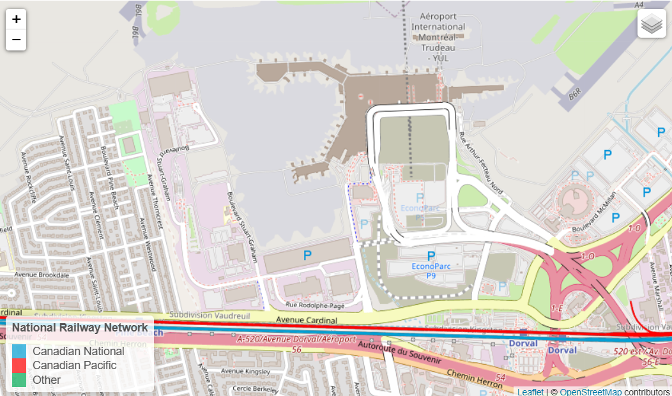
If anything, the line could stop at Trudeau Airport, then stop in Downtown Montreal. Then there is a choice to go east along the river to Quebec City, or if Laval is that important, have the line go north to Laval then turn east to Quebec City.
Now here is Ottawa:
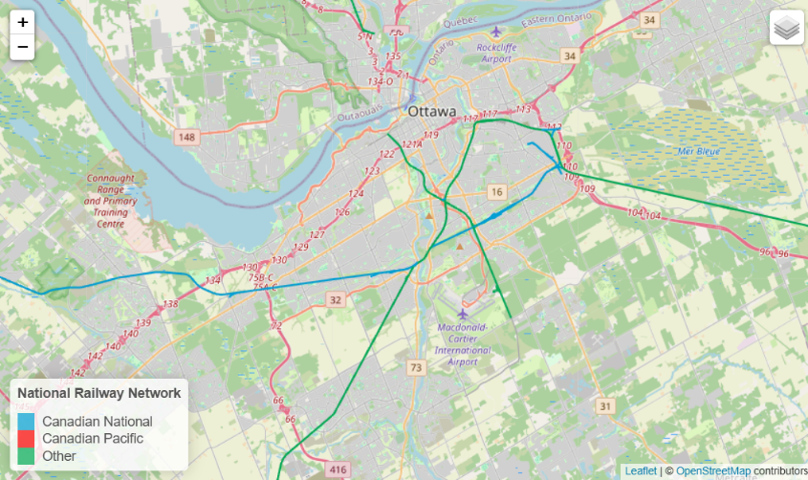
A station in the suburbs near the airport makes the most sense. But Alto’s plan shows the rail line crossing the Ottawa River near Hawkesbury, though there are no existing rail bridges across the river anywhere near there, while both CN and CP have sets of rail bridges across the Ottawa River west of Montreal at Dorion. Likely one set of bridges alone could handle the freight traffic with the other set of bridges shared by VIA and Alto with Alto having priority. If the bridges can be widened or new parallel bridges built later, this represents a cost saving and speeds up construction.
The big public benefit is that VIA will own its tracks (in conjunction with Alto and/or the government) instead of CN owning the tracks, so VIA’s current problem of sharing the tracks and being second priority to CN’s own operations is gone.
The portions of tracks close to Toronto and Montreal where the right-of-way will be shared by Alto and VIA works and is likely unavoidable, but now ALTO connects to Trudeau Airport, so someone from Quebec City or Ottawa can take the rail directly to an airport with international flights and flights to the rest of Canada.
This is the possible staging, over a much longer timeframe, for adding parts of the system where speeds can be highest:
- Stage 1: New HSR tracks from west of Montreal to Ottawa – with high-speed rail only covering this portion.
- Stage 2: New HSR tracks from Ottawa to Kingston – trains can continue to/from Toronto so high-speed rail service can start at this point.
- Stage 3: New HSR tracks from Kingston to Belleville – though there will be no stop in Belleville itself, but there will be a link to the VIA tracks here, to speed up the service.
- Stage 4: HSR tracks from Belleville to Oshawa – completing the new right of ways needed.
Where possible, the existing tracks can be upgraded, straightened or small acquisitions of adjoining land made to allow for more appropriate curves or improving the system to allow even higher speeds – incremental improvements that benefit Alto or both Alto and VIA.
By having stops at Trudeau Airport, Kingston and Oshawa, the potential ridership will be far higher, and the line will pass closer to higher density areas of Ontario. A Laval station is still possible, but it is between Montreal and Quebec City as opposed to being between Montreal and Ottawa. The area east of Toronto, around Oshawa, includes a lot of people who do not have an airport with passenger service. Trudeau Airport can mean a lot of passengers, and it is possible to still have a stop in Laval. People from other cities along Lake Ontario or the St. Lawrence could travel to Kingston by car, bus, or by VIA train and then transfer for the rest of their trip.
The other key advantage is that other than very close to the cores of Toronto and Montreal, there is now some redundancy – if any portion of the line has to be shut down, trains can bypass that section by using tracks normally only used by VIA. There may be a delay, but service can continue instead of being cancelled entirely or passengers having to be loaded into buses to get to somewhere where service resumes or their destination. Oshawa is certainly more likely to provide high numbers of passengers than Peterborough.
In the Toronto to Montreal corridor, VIA service is heavily subsidized and slow – according to Grok AI, Toronto to Montreal one-way on average has revenue of $113 per passenger and a subsidy of $50 per passenger, for a cost of $163, and almost a third is subsidies. In contrast, economy fares on Porter Airlines from Billy Bishop airport to Montreal are around $120 to $180, with no government subsidy.
Plus, there is the cost savings from not building a new bridge over the Ottawa river, and my route is shorter and more direct.
What is the point of high-speed rail? A bunch of business executives or government managers taking less time to travel cannot produce billions in economic value. This is particularly the case with Zoom/videoconferencing and similar services that have taken off since Japan, France, and some other countries started high speed rail. These countries are also denser and many people take rail regardless. In Canada, the densities are so relatively low, the country so big, and energy so cheap that flying makes more sense.
A non-stop flight from Toronto to Montreal is only in the air for about one hour and twenty minutes. To Ottawa might be one hour or one hour and 10 minutes. Montreal to Ottawa is under an hour. Montreal to Quebec City is 40 minutes to just under an hour depending on the airplane and so on.
Flying uses four to six times the energy as high-speed rail, assuming a 300-mile trip. A Boeing 737 uses roughly four-and-a-half to six gallons of fuel per passenger for a one-way, 300-mile trip. One person in a Honda Civic might use seven-and-a-half gallons of gas, one way. If two or more people are in the Civic, it uses less energy than flying. Four people in a car is best, a bus is even better, but a lot depends on how full the train or bus is.
If the goal of high-speed rail is to reduce GHGs, that would be fine, except our policy now seems to be to extract and export as much fossil fuels as possible, with massive construction projects that will require energy to build. High speed rail will also require a lot of bridges, tunnels, and so on – while the highways and airports generally can handle the status quo and some growth.
If Canada wanted to reduce GHGs in future, particularly to meet targets that are total emissions and not “per capita”, the best solution is to have low or no population growth, or even let the population slowly decline as is happening in Japan and Korea now. The insane Century Initiative policy of high population growth ignores the increasing costs of eliminating GHGs with more people, in order to have the same total emissions.
The average price of a VIA rail ticket is $80 to $150, one way. But there is a $50 to $60 subsidy, and with fewer VIA passengers, that would go up. According to Grok AI, the cost of flying from Toronto to Montreal is between $70 and $25, typically around $110-$120, and airports get no subsidy. In fact, the government get lots of rent from Pearson under the current model.
The real problem right now is that VIA does not own its tracks. Until CN was privatized in the 1990s, the federal government owned all of CN, including those tracks.
Alto does nothing to improve service on the current VIA corridor. In fact, VIA will lose passengers and be a worse service as a result. Alto cannot charge more than maybe $200-$250 one way from Toronto to Montreal, but likely would want to offer a premium service more like business class. Most people would likely keep flying, particularly if their destination is not downtown, but home or elsewhere in the burbs.
The problem with flying is the time between getting to the airport, security, boarding, and so on and then waiting for luggage. Flying from Billy Bishop is faster than Pearson, I assume, but there is an advantage to rail over air in terms of being able to serve downtowns, and not having the high security or time waiting to board, take off, landing.
If we expropriated both CN and CP mainlines, it would not include the marshalling yards. Some new freight-only sections of track might need to be built, and possibly it could be privatized, or jointly run by the government and the two railways. So, even if the cost of acquiring both lines together is high, it will earn back much of the revenue from freight traffic in tolls or fees, or the CP freight portions could mostly be sold off in some form so that both companies can maintain freight services on mostly joint tracks.
The big problem with rail is that the companies run parallel vertical monopolies, as opposed to the tracks being run like a utility or toll road, with the trains paying for access and use. If every airline had to have its own airports, we would say that is nuts, but we accept this with rail because that is how they started.
If we want HSR, then we should build a new line along the west side of the Ottawa river to near Ottawa airport, with a stop at Dorval/Trudeau airport. Then, build a second stage from Ottawa to Kingston. If in future there is justification, then we should build new HSR sections from Kingston to Belleville, then Belleville to Oshawa.
All content on this website is copyrighted, and cannot be republished or reproduced without permission.
Share this article!




The truth does not fear investigation.
You can help support Dominion Review!
Dominion Review is entirely funded by readers. I am proud to publish hard-hitting columns and in-depth journalism with no paywall, no government grants, and no deference to political correctness and prevailing orthodoxies. If you appreciate this publication and want to help it grow and provide novel and dissenting perspectives to more Canadians, consider subscribing on Patreon for $5/month.
- Riley Donovan, editor