

It seems like Prime Minister Mark Carney spends more time outside of Canada than in it, since he travels so much to conferences, meetings with other world leaders, or to sign yet another free trade deal.
Carney is by education and profession an economist, and essentially Anglo-American economists are neoliberals who believe in free trade deals and the freer flow of goods, services, capital, and even people across borders. Even if Canada was not in a trade war with the US, this would likely be Carney’s approach to trade and foreign relations. When all you have is a hammer, everything looks like a nail. Carney’s approach is not that rigid; he is willing to do creative deals, notably one with Brazil where Canada will subsidize the preservation of some of the Amazon.
But clearly, since the start of 2025, Carney’s, and Canada’s, greatest external threat has been Donald Trump and his approach of reversing much of the US foreign policy and trade policy undertaken since World War Two; the policies which led Canada to increasingly closer integration with the US in foreign policy, defence, and trade. The US is no longer a reliable partner for other nations, particularly Canada.
About a month ago I heard about a new book that looked at how Canada could meet the challenges brought about by the US showing itself to be an unreliable partner, under Trump and quite possibly under future presidents, even if the next one is not a populist Republican adopting some or all of his approaches to Canada and the world. The book is Canada After America: A strategy for Prosperity in a Changed World written by Ricardo Hausmann and Eric Protzer, and published by Sutherland House in Toronto.
The prologue of the book includes this description of it and its authors:

“Canada After America is a critical intervention into this ongoing debate. It is written as part of the McGill Max Bell Lectures on economic policy, launched in 2023, to provide the analysis and practical ideas our country needs to plan for a more prosperous future. While previous books in the series discussed climate, competition, and immigration policy, this year we focus squarely on Canada’s growth challenge.
Our co-authors are the renowned Venezuelan economist Ricardo Hausmann, founder of the Harvard Growth Lab—the world’s pre-eminent centre for applied growth policy—and his colleague Eric Protzer, a Canadian economist with expertise in economic growth and development. Over the past two decades, the Harvard Growth Lab has worked with governments in more than thirty countries—including developed economies like Japan, Australia, and the United States—to diagnose the key constraints on growth, identify paths to diversification, and develop tailored policy solutions. Its core working assumption is that the biggest barriers to and opportunities for growth are place-specific and cannot be addressed with a one-size-fits-all economic theory or formula.”
Now, Harvard is one of those great American “brands” that stood for excellence, like Tiffanys, or Cadillac, but having read this book, I was sadly disappointed.
The book’s authors are economists, but they get a lot wrong about Canada, and Canada’s history, even though one is Canadian. But then they also have the usual blind spots, priorities or views typical of Anglo-American economists.
But even so, the books do contain several dozen interesting graphs and some ideas and analysis I found valuable. Overall, it missed the target.
An easy example is that the authors repeatedly suggest that Canada has always been willing to rely on the US to drive prosperity. This is the text at the start of the book:
“For much of the period after World War II, Canada made a bet that was so sensible it hardly felt like a bet at all. It built its prosperity around deep economic integration with the United States.
The logic was obvious. Canada sat next to the world’s largest economy. The border between the two countries was long, peaceful, and largely undefended. The two societies spoke a common language in much of the country, shared broadly similar institutions, and operated under a web of trade agreements that made continental production possible.”
Canada has vacillated between wanting closer ties with the US and worrying that this would be a huge mistake that threatened our sovereignty. It is true that since the 1988 Free Trade Agreement, then NAFTA and CUSMA, Canadians accepted economic integration with the US. This is because it was difficult to reverse and none of our political elites thought it made sense to break away after the bitterly fought 1988 election, where the Conservatives won and implemented the deal, even though more people voted for parties that opposed it (Liberals and NDP).
In the 1993 election, Jean Chretien promised to make changes to NAFTA before implementing it, then in power he backed off on even this mild promise. Reversing the FTA itself would have meant that many of the things lost would not be regained (manufacturing plants closed and so on). This was the era of globalization, the World Trade Organization (WTO), and the post-Reagan and post-Thatcher triumph of neoliberalism. The pendulum was swinging away from the New Deal and towards free markets.
But Canada also briefly had a free trade deal with the US that the Americans cancelled in 1866, after their Civil War, and this was a factor in Confederation taking place. Canadians rejected another free trade deal with the US in the 1890s, then again in 1911. Prime Minister Mackenzie King contemplated a third attempt, but decided against it.
It was not until the 1965 Auto Pact that Canada opted for economic integration, in part because Canada had lost privileged access to the UK and Commonwealth countries which had been one of the reasons US branch plants in autos had been established and grown. Prior to the Auto Pact, Canadian governments had little problem with US foreign ownership outside of a few industries, mainly banking, broadcasting, transportation (airlines and railways) and a few other sectors. Prime Minister Diefenbaker opposed north-south integration and wanted closer economic integration with the UK.
Pierre Trudeau proposed his “Third Option” after the Nixon shocks of 1971. Canada was also hit by the US Smoot-Hawley tariffs in the 1930s.
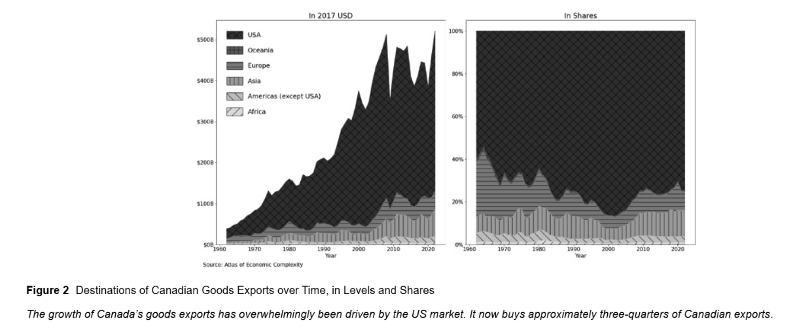
What the authors of Canada After America do get right is the ideas around the importance of proximity. They explain the “Gravity of Trade” a theory that proximity and market size are key factors in determining the volume of trade. And certainly, Canada imported a great deal from the US, and without trade deals or any policies pushing integration, the US imported things like softwood, pulp and paper, iron ore, uranium, and other things because Canada was close, reliable, and open to most US investment. If anything, the author’s own graphs show that Canada is less reliant in 2025 on US trade than previously. See below.
The book lays out a “Post-American Agenda” of five parts. Some of these are obvious and we are already doing them, but some are total nonsense in my view.
Again, this is taken from the book:
“The argument of this book is, therefore, simple, though its implications are demanding.
First, Canada must reduce its vulnerability to the United States by building a more global export portfolio. This does not mean turning away from America. It means making sure that Canadian prosperity is not so dependent on one political system, one market, and one president’s whims.
Second, Canada’s ability to diversify is constrained by geography. For most of its modem history, Canada benefited from being next to the world’s largest economy. If the United States becomes less reliable, Canada starts to look more like Australia: a rich, resource-abundant, immigrant-heavy country whose major markets lie across oceans. That does not make trade impossible. Australia is prosperous. But it changes which industries are realistic. Some supply chains are regional because they require intense coordination with nearby suppliers. Others are more resilient to distance. Canada’s future strategy must be built around this distinction.
Third, many of the best remoteness-resilient opportunities are innovation-intensive. Natural resources and agriculture will remain crucial, and Canada should stop hobbling some of them with counterproductive policies. But the most promising sophisticated export opportunities include areas such as aerospace, defence, life sciences, advanced services, and certain globally organized manufacturing niches. These sectors require commercial research and development, large firms, specialized capital, smart procurement, and regulatory systems that help rather than hinder innovation and scale.
Fourth, Canada’s housing crisis is not only a moral and generational scandal. It is an economic blockade. Innovation thrives in large cities because they bring together specialized people with complementary skills. If housing shortages prevent those cities from growing, Canada will price talent out of the very places where its future industries need to form.
Fifth, none of these reforms will be easy. They will create losers as well as winners. Farmers protected by supply management, small businesses benefiting from preferential tax treatment, homeowners who oppose density, municipalities that enjoy development fees, provinces guarding their turf, and bureaucracies comfortable with existing procedures will all have reasons to resist. That is why the final question is not only economic. It is political and civic: can Canada summon enough common purpose to make changes whose benefits are national but whose costs are concentrated?
The answer should be yes. Canada has advantages that are easy to miss in moments of pessimism. It is rich. It is stable. It is democratic. It has abundant natural resources, world-class universities, strong cities, deep immigration networks, and a population that still trusts its fellow citizens more than most societies do. It has problems, but they are not mysterious. Many are the result of policies and institutions that can be changed.”
I think the authors go way off the track on raising housing and densification as key issues, and there are flaws in their other sections.
One term I had never heard of before is “ascriptive nationalism”, which they pair with its opposite of civic nationalism.
Societies create a sense of us in many ways. Political scientists often distinguish between ascriptive and civic sources of national identity. Ascriptive identities are built around characteristics people inherit or are born into: ancestry, race, language, religion, birthplace, lineage, inherited culture. Civic identities are built around shared institutions, laws, rights, political values, and a willingness to participate in a common public life. The distinction is useful, but real countries are hybrids.
I usually think of “ethnic nationalism” as the term, but this does not cover countries where religion or language might be the main common element. The authors praise Canada while also noting that Canada’s lack of a single ascriptive identity is an asset that makes us open to immigrants.
At the end of the book, in a section called “The National Bargain”, they list seven policy reforms, and I have taken their words and edited it down as follows:
“This has been a book about economic policy. But the reforms we propose are not a menu of technocratic fixes. They are a national bargain. Each asks something of particular groups. Each offers a broader gain. And on some issues, Canada cannot simply split the difference. It has to choose.
First, Canada must treat natural resources as strategic assets. Oil, gas, minerals, hydroelectricity, uranium, potash, forestry, agriculture, and critical minerals are not the whole Canadian economy, but they are indispensable parts of it…
This does not mean Canada should ignore climate change. It means Canada should focus climate policy on the margins that matter…
Second, Canada must build remoteness-resilient industries. Geography matters. Canada is far from many of the world’s largest markets, and distance imposes difficulties for goods that are heavy, perishable, or dependent on tight regional coordination of supply chains. But some industries are less punished by distance because their value is overwhelmingly embodied in knowledge, intellectual property, certification, trust, design, precision, or strategic necessity. Pharmaceuticals, medical devices, aerospace, and defence are central examples.
Third, Canada must change its innovation policy from a generic subsidy system into an ecosystem-building system. SR&ED and related policies should be less size-biased. The problem is not that small firms receive support. Small firms are where many new possibilities begin. The problem is that policy should not create incentives to remain small, avoid scaling, or fragment R&D across firms that never become major performers…
In leading innovation economies, much business R&D is done by large firms. Canada has too few of them, especially in the industries that matter for a post-American strategy. The absence of the big is not the fault of the small…
Fourth, Canada must build a system of capital that can scale up promising ideas to full commercial fruition. Capital is not just money. Good investors identify founders, help them recruit, connect them to customers, solve governance problems, syndicate financing, and teach firms how to grow. The best venture ecosystems are learning systems. Founders become investors. Investors become better at recognizing talent…
Canada’s venture ecosystem is better than it was, but it remains too thin in too many sectors, especially outside software. Successful founders should be encouraged to reinvest their experience into funds, boards, and new firms. Pension funds should not be forced into patriotic underperformance, but they should be encouraged to engage with the learning process in Canadian venture capital and to use what they have learned from investing abroad to strengthen domestic capability.
Fifth, Canada must use procurement strategically. In sectors such as health and defence, the state is often the main customer, regulator, payer, or standard-setter. If public procurement is slow, fragmented, risk-averse, or indifferent to domestic learning, Canada will struggle to build firms in precisely the sectors where public demand matters most. This does not mean buying inferior Canadian products regardless of quality. It means becoming a demanding customer that helps firms test, validate, certify, improve, and compete. That is the kind of customer that can catalyze and scale innovation.
Too often, procurement is fragmented across Canadian provinces rather than cohesive on a national scale…
Sixth, Canada must fix the urban foundations of growth. The housing crisis is not only an affordability problem. It is a land-use and agglomeration problem. Canadian zoning mandates low densities in many high-opportunity areas, especially near jobs, transit, universities, hospitals, and existing infrastructure. By limiting how many people can live where demand is strongest, regulation makes land artificially scarce. It pushes people farther apart, lengthens commutes, reduces access to opportunity, weakens agglomeration, and converts productivity gains into higher rents and land values.
Housing shortages and high prices are the visible symptoms. The underlying disease is a governance system that gives municipal veto points too much power over regional and national labour markets. Successful cities should pull people in…
Seventh, Canada must restore the immigration consensus. Immigration is essential to Canada’s demography, talent base, universities, entrepreneurship, and civic renewal. Silicon Valley did not grow all of its people from scratch. It attracted them. Canada has a similar opportunity, especially as the United States becomes a less predictable destination for students, scientists, engineers, and founders.
But immigration only remains politically sustainable when the state is seen to be in control. Canada should return to a controlled, transparent, merit-based system that emphasizes skills and long-term contribution. It should set levels consistent with housing, infrastructure, public services, and institutional capacity. It should not confuse openness with administrative drift…
These reforms are connected. Resource prosperity generates fiscal and strategic capacity. Remoteness-resilient industries generate diversification. Innovation ecosystems create firms. Venture capital and pensions help firms scale. Procurement creates demanding customers. Urban reform allows agglomeration to work. Merit-based immigration brings talent while sustaining public consent. Civic identity holds the bargain together.”
So, this is a mixed bag of good and bad.
To start, they want Canada to essentially double down on natural resources, commodity and energy exports, which they see as Canada’s main comparative advantages. They compare Canada to Australia, which is a country that is remote from most major markets. Without the US market, they see Canada as being in a similar situation.
The authors do not consider the crowding out factor. Putting most of Canada’s capital, skilled trades and infrastructure investment into exporting commodities, where production is increasingly automated and reliant on expensive foreign machinery, will hinder Canada from developing other industries where productivity is higher.
They essentially write off the Canadian manufacturing sector, other than aerospace, pharmaceuticals, and defence. This includes the auto industry in Ontario.
And of course, natural resource and commodity production is very energy intensive, and hydro power is hard to apply to many of these industries except in the refining or later stages (like smelting aluminum in Quebec).
Without reliable and inexpensive access to the US market and supply chains, Canada’s auto industry is seriously threatened. The authors show how southern Ontario has been close to US supply chains, and similar such clustering of the auto industry in Europe, Japan, and Korea made those places successful at producing and exporting cars.
Of course, Canada had an auto industry before the 1965 Auto Pact, and it could continue to make cars and trucks by tapping into US supply chains, but the problem is that Canada’s auto industry is losing access to selling parts and completed cars into the US, as was the case prior to the Auto Pact.
In 2024, before Trump’s return, about 1.9 million cars were sold in Canada, and about 1.3 million made here. Only about 250,000 of the cars made in Canada were sold here too. About 200,000 cars are exported to Mexico and other countries. And since NAFTA was signed, Canada has been losing out on new plants or production to low-wage Mexico, or to southern US states that offer anti-union laws and often high incentives to locate there.
Canada’s auto industry could limp along, producing a wider variety of vehicles in small quantities mainly for the Canadian market, with some exports, as was the case before 1965. The most popular pickup trucks and SUVs would be the most likely products to remain, with low volume and the most inexpensive cars imported, as well as the lower volume, more expensive cars also being imported. Canada’s steel industry, again mostly based in Ontario, is in a similar situation too.
The November 2026 US midterms happened after the publication of Canada After America, and the Democrats seem keen to eliminate most or possibly all of the Trump tariffs on Canada, and there are also court cases in the US related to these tariffs.
There is also the possibility that Carney might get concessions in any new trade deal with the US, but the fact remains that Ontario’s auto industry will likely shrink considerably without reasonable access to the US market being restored. But it is also true that the authors really do not offer much of anything about how Ontario, and Canada, can replace manufacturing losses or diversify manufacturing other than in a narrow range of products or industries.
For me, a major omission is the lack of recognition of the high level of foreign investment and control of Canadian corporations. Apart from a few years under Pierre Trudeau, Canada was always very open to foreign investment, and even encouraged it, and since Brian Mulroney and the 1988 FTA, government policy has been to accept limitations on our ability to review or stop foreign investment or takeovers. This policy continues under Carney, who is openly encouraging foreign investment in the major infrastructure projects he is trying to see get built.
The authors of the book note that Canadian tax and other policies promote small businesses, and we have a lack of medium and larger businesses. They attribute this to small business owners not wanting to grow their companies, and ignore that the incentives might be influencing businesses to limit growth to avoid ending up in higher tax brackets or growing too large to qualify for incentives.
Obviously, business owners can manipulate expenses or revenues to some degree. But the simplest explanation is that if your business is growing into a higher tax bracket over $500,000, then the easiest thing is to set up a second small business corporation and move some of the activities, and profits, so there are two related small businesses paying lower taxes instead of one bigger one.
Economists looking at Canada’s economic under-performance often raise the two issues: R&D, and low productivity. Hausman and Protzer are not that different, and here is part of their analysis:
“…Canadian business R&D is unusually spread across firm sizes, whereas very large firms lead the R&D landscape in peer countries… Canada has too few large R&D performers, especially in the industries that matter for a post-American export strategy. Software is a notable exception…
The question, then, is not whether Canada should support startups or small businesses. It should. The question is how to design support so that firms are encouraged to scale rather than remain small, and how to build the public goods and sector-specific institutions that make scaling possible…
This leads to our next chapter. Canada’s post-American strategy cannot be only a trade strategy. It cannot be only a resource strategy. It cannot be only a pipeline strategy, though pipelines matter. It must also be an innovation strategy focused on the sectors where geography gives Canada a fighting chance.
Canada has spent decades benefiting from a uniquely favourable geography… It must identify industries whose supply chains can survive distance. And it must build the innovation system those industries require.”
Chapter three of their book focuses on the need for Canada to have an economy more rooted in innovation.
My own view of why Canada’s R&D numbers are low is because of a number of factors. Too much of our economy is in commodities (or staples) like agriculture, forestry, mining, and energy. R&D is more common in the inputs we need (seeds, machinery, and so on) or in later stages that use raw materials.
Then, we also have too much foreign investment and control of our economy. Branch plants do not do R&D. Canada has few multinationals (outside of banking, insurance, and finance) and often R&D is done in the country where the head office is. In the past, Canadian companies licensed foreign technology, patents, designs and so on from the US, which often limited exports under the agreements.
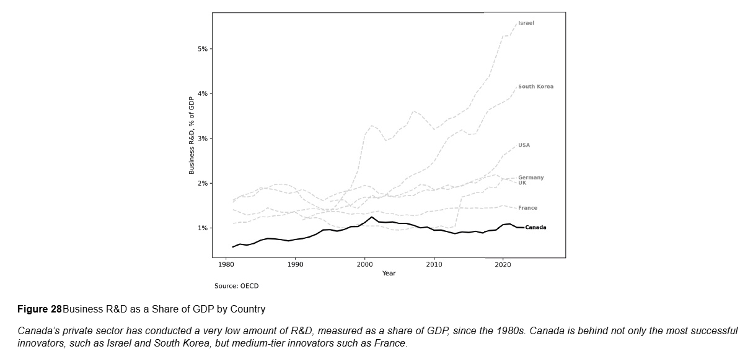
The authors dismiss the branch plant issue, but produce some interesting charts using mostly OECD data. This shows the overall picture compared to other countries:
This one compares us to other countries by sector:
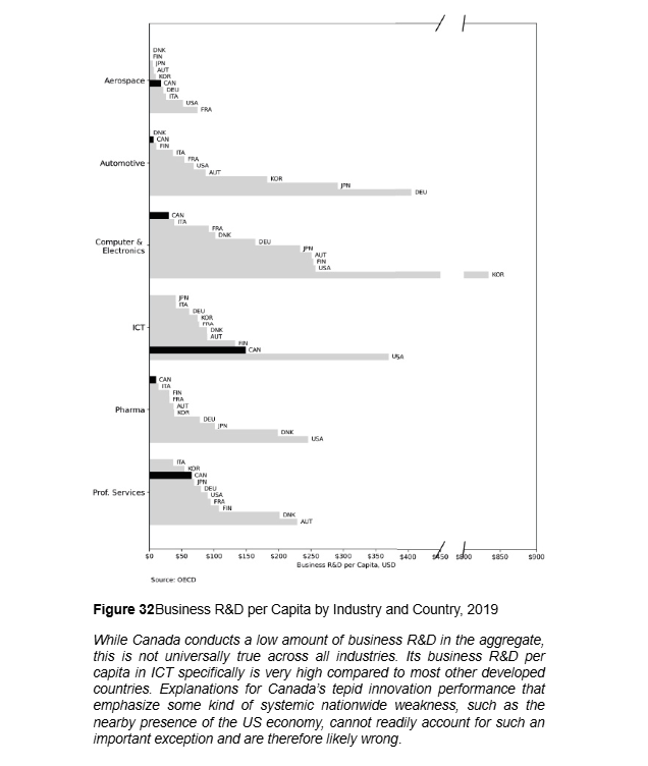
Of course, automotive, electronics, and pharmaceuticals are sectors with high levels of foreign ownership and branch plants. Information and Communications Technology (ICT) is more related to services than manufactured things, so we do better.
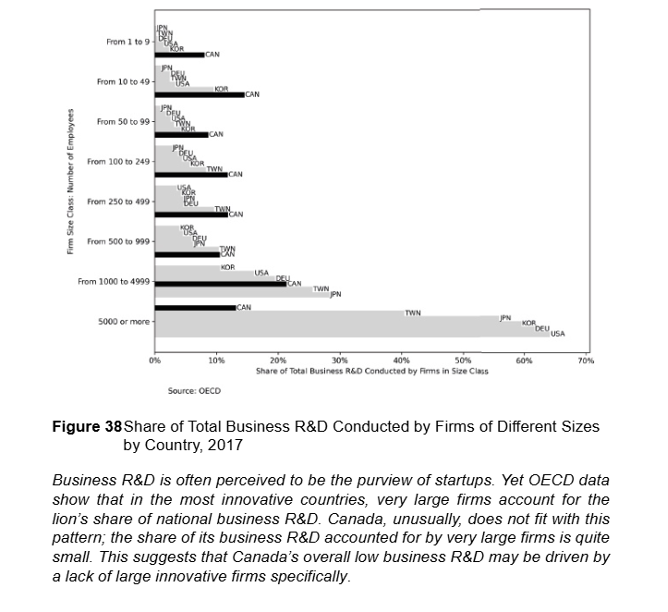
Look at the above. Then consider this graph:
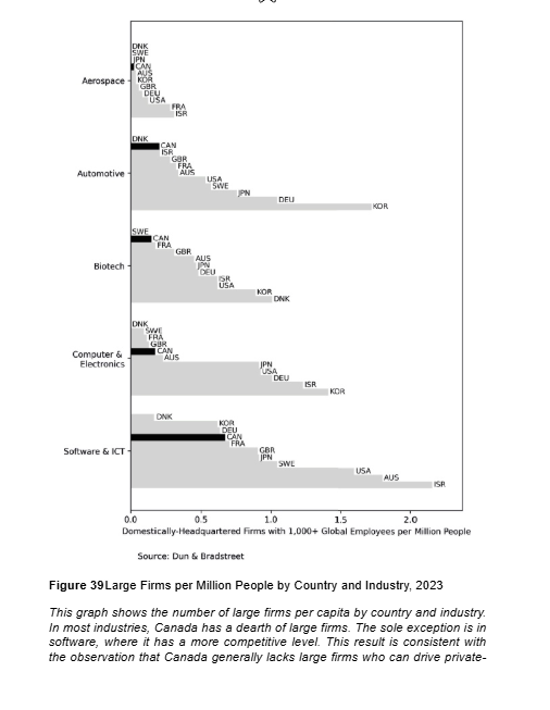
Contrast Canada with Japan and Korea, countries which did not permit foreign ownership in autos, and which were decimated by World War Two. In 1965, when Canada signed the Auto Pact, Hyundai did not even exist, and the first cars in Korea were only built in 1955.
The authors say “The question is how to design support so that firms are encouraged to scale rather than remain small”, but they ignore Canada’s history of not only allowing branch plants, but not stopping takeovers (or mergers) with foreign companies as companies become middle sized. Since Mulroney and the FTA in 1988, the government has often signed away, or limited, the right to review or stop takeovers, or at best, Canada has allowed takeovers but put in place some conditions. But as we are seeing lately with US-owned Stelco, which used to be Canadian owned, often the terms can do little to protect Canadian production or are not enforced at all.
Hausman and Protzer get it all wrong – the problem is not so much that small Canadian businesses do not want to grow, but rather that selling out to foreign investors or corporations is so much more attractive, and our government has never been as willing to stop takeovers or competition from branch plants as other countries, particularly in Asia.
Where Canada After America really falls down though are the sixth and seventh items on their list of seven reforms they recommend.
Their sixth point on density and housing is essentially the same YIMBY positions imported from the US, when it is now abundantly clear that high immigration (particularly non-permanent residents) was the main factor behind what is now clearly a real estate bubble that has burst.
They say “Canadian zoning mandates low densities in many high-opportunity areas, especially near jobs, transit, universities, hospitals, and existing infrastructure” – have they been to Toronto or Vancouver? Canada was building record number of homes in the last few years, many of which are still not completed but will further add to oversupply. Toronto and Vancouver have green belts limiting sprawl, and transit systems that put most US cities to shame. Ontario also has the unique Ontario Land Tribunal (OLT) which can over-ride local government and sides with developers over 95% of the time, by some estimates.
Large Canadian cities are denser than US cities of similar size. And what is odd is that if dense, walkable cities were the key to innovation, then Europe, Japan, and Korea should be far more innovative that the US, which has dominated computers and IT for decades. And the US centre of innovation was not Downtown San Francisco, but nearby suburban Silicon Valley, though now people commute daily from Downtown San Francisco to the low-density suburbs, not the other way around.
The “Research Triangle” in North Carolina was based on universities, not on large or dense major cities.
Where dense cities do drive innovation is more in cultural trends than in technology. The Punk Rock and New Wave music trends started in the 1970s in London, New York, and Toronto. Writers, musicians, filmmakers, actors, and visual artists often thrive in dense urban areas.
Did these guys never read Jane Jacobs? She wrote “Old ideas can sometimes use new buildings. New ideas must use old buildings.”
Generally, much innovation in North America took place in places with cheap old industrial buildings – the “brick and beam” districts with cheap rent that attracted both artists and entrepreneurs. In densified Toronto, and in New York, those areas have been gentrified and the artists and startups are gone. Meanwhile, places like Detroit have been hailed as areas where new startups are common because of the abundant cheap old buildings.
Lastly, we come to their seventh point on immigration.
The authors state that “Canada must restore the immigration consensus. Immigration is essential to Canada’s demography, talent base, universities, entrepreneurship, and civic renewal.”
Canada since 2021, or since 2015, or since 1990 (depending on the person) has had legal immigration levels far, far higher than the US, and only Australia and New Zealand are in the same territory. Canadians are not “anti-immigrant”, but the consensus was mostly among Canadian elites (government, business, media, and academia) while polls have almost consistently showed that far more average Canadians wanted immigration reduced than wanted it increased. But there is has been no popular movement to have immigration levels at zero.
And more importantly, even prior to the November 2026 budget, the Carney government policy was to keep immigration level at rates 46% above 2014, the last full year of the Conservative Harper government being in office.
Many provincial premiers (Alberta, Nova Scotia) had been calling for massive increases in population. Canada’s point system is already based on bringing in highly skilled and educated immigrants. Mark Carney is not a populist like Donald Trump, and Ontario Premier Doug Ford, who is considered to be a populist (and not a traditional Conservative) is not anti-immigrant or anti-immigration, but is pro-development and aligned with the real estate industry that needs high population growth to drive profits.
So, saying Canada should “return to a controlled, transparent, merit-based system that emphasizes skills and long-term contribution” is wrong because, other than in temporary workers and foreign students, this has always been the case since 1968, though there are legitimate criticisms that the current “Express Entry” system is letting in people with low scores to meet quotas on things like speaking French (and being willing to settle in areas that have low numbers of Francophones).
The book was written before the 2026 Budget, which is actually increasing the number of permanent residents in 2027 to 662,000 but including 282,000 people under “one time” programs separate from permanent resident admissions, breaking with previous norms on immigration reporting.
In summary, Canada After America does have some interesting ideas and issues, and lots of graphs that are thought provoking, but a lot of it misses the mark, in part because the authors think like conventional North American economists and seem to be applying ideas that are half baked in relation to Canada, particularly on densification and immigration, but also on why Canada is lacking on both R&D and in having a high level of large, domestically headquartered corporations, unlike the US and most of our peers.
All content on this website is copyrighted, and cannot be republished or reproduced without permission.
Share this article!




The truth does not fear investigation.
You can help support Dominion Review!
Dominion Review is entirely funded by readers. I am proud to publish hard-hitting columns and in-depth journalism with no paywall, no government grants, and no deference to political correctness and prevailing orthodoxies. If you appreciate this publication and want to help it grow and provide novel and dissenting perspectives to more Canadians, consider subscribing on Patreon for $5/month.
- Riley Donovan, editor