
Have you ever wondered what Canada would be like if we did not have the immigration crisis that we are currently facing? Assuming you cannot remember those ancient days, there still exists a plot of this country that demonstrates the way and quality of life that would exist if there were no mass immigration.
The area in and around the Cypress Hills region of Saskatchewan is quite rural, populated by small towns which dot the dry plains, quaint cafés to shield you from the winds, and good old boys who will give you a nod as you pass each other by.
Yet as you travel this region you notice something distinctly absent, which makes it unlike any other part of Canada: immigrants. The gas stations are clerked by old folks, the diners are waited by young women, and the fast food is prepared by teenagers.
When you pull into one of these towns off the Trans-Canada Highway, it is like you have been sent through a portal into an alternate dimension where Canada was never harried by mass immigration.
One wonders how such a thing can exist in a Canada that has suffered so much at the hands of its leaders, in an attempt to stamp out this very environment from existing. Well, in my visits to this region I have asked this very question, and the answer appears to be deceptively simple.
There is no food delivery, and there is no HR. That is it.
Yes, if you go to the largest city in the region – Swift Current – you will find some immigrants about, but by and large there is no reason for them to move there. They cannot make their low income contract money from food courier services, and they cannot abuse the Temporary Foreign Worker program.
It is truly astounding how something so simple can have such massive emanations, and goes to show the extent to which Canada’s immigration crisis is the fault of the way our society is structured – and whom we entrust with the determination of its future.
If you believed the media and talking heads, you would conclude that this region of Saskatchewan must be drowning in its homogeneity and that it must be on the brink of total economic collapse.
The reality of the situation is not as simple as they would have you believe.
You would think it is providential how perfect of an analogue the Southwest of Saskatchewan is for Canada as a whole. Swift Current, the aforementioned largest city in the region, has an average age that exactly matches the national average: 42 years old.

As well, the region has all the services and first world amenities that one would expect. And on top of all that, it is only an hour drive on the Trans-Canada Highway from multiple cities.
So, what do we learn when we use this region as a microcosm for what Canada would look like without immigration?
First of all, I will have to surrender a point to the pro-immigration crowd. There is a serious age demographic crisis in the region. Yet, this comes with a major caveat. I would retort that it is this very demographic crisis that is spurring an array of economic and civic development.
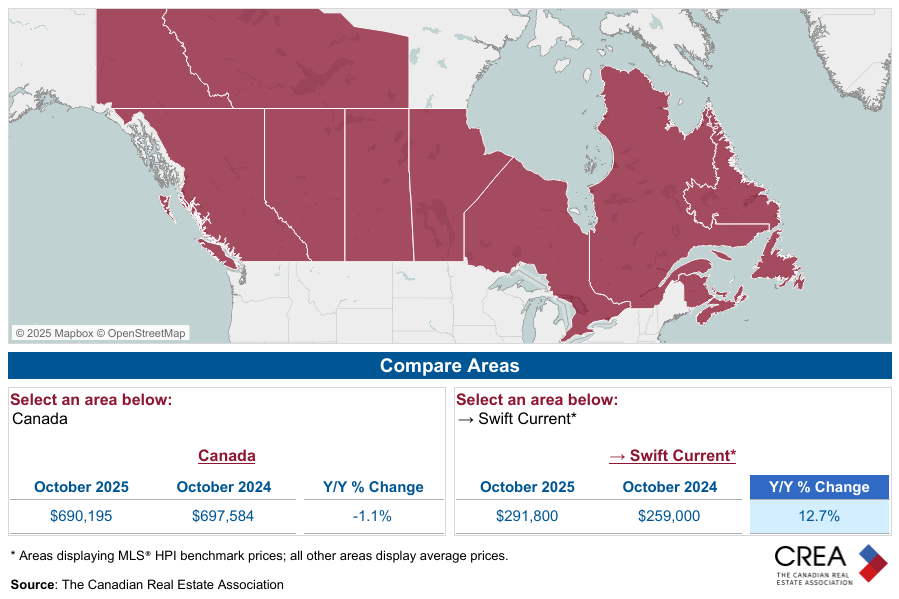
According to the Canadian Real Estate Association, the average cost of a Swift Current home in October 2025 is just shy of $400,000 less than the national average. Which, in terms of home prices, is an astronomical amount – especially if we compare it to just one hour away over the Alberta border.
The region of Medicine Hat has an average home price of $399,161 – approximately $108,000 more on average than the Southwest of Saskatchewan. If we look at specific listings in the Southwest of Saskatchewan, the difference in residence costs becomes even starker. In places like Tompkins, Eastend, Shaunavon, and other surrounding towns you can find listings for houses that go as low as $55,000. After looking for myself, I found two homes in Gull Lake – that were perfectly livable without work – selling for $39,900 and $64,500 respectively.
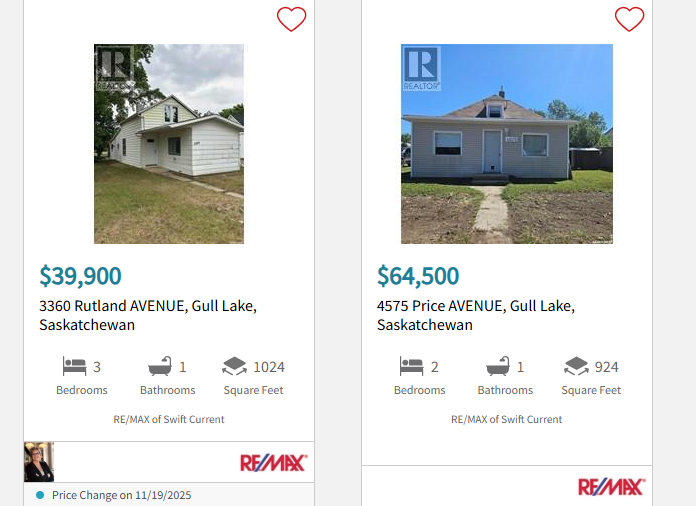
We are living in an era where many Canadians are being priced out of their dreams of owning a home. Pundits will claim that these housing prices are organic, and that we need to work harder or owe more to the bank in order to get a home. Yet, Saskatchewan’s Southwest proves that, without the strain that immigration places upon the economy, the dream of home ownership is very achievable.
Naysayers may attempt to argue that these houses must be in a state of disrepair, or surrounded by unfriendly or dangerous folks. There is no amount of evidence to the contrary that I can provide to these kinds of people that would be satisfactory.
Some people are just stuck in the programming that has been fed to us by the government, media, and education system. I do not necessarily blame them for their incredulity either – there is a common aphorism which goes “If it sounds too good to be true, it probably is“. In an age of scam artists, multi-level marketers, and Ponzi schemers, it is good to have a healthy dose of skepticism.
I would merely ask these naysayers to visit for themselves; book viewings of these houses, and interact with the people of these neighbourhoods to see the truth with their own eyes.
Another factor to consider in addition to housing is wages. Now, this is harder to quantify for the nation at large, but I can speak on my own employment experiences.
Generally speaking, there is steep competition for entry level employment in Canada, and what entry level jobs do exist often come at the cost of low wages. I am sure we have all heard the stereotype of higher education merely qualifying you for an occupation at a Starbucks.
In Saskatchewan’s Southwest, however, there is an interesting trend. If you look at job listings for Gull Lake and Maple Creek, you are likely to see wages in the $19-$23 range for positions that only require high school diplomas, or basic post-secondary of any kind.
This is only taking into consideration the ones that are posted online – of which very few are – which goes back to why there are so few immigrants here in the first place. Almost none of these businesses have formal HR departments.
I will tell you an anecdote to support this. While I was in Eastend, I visited a bookstore that was inside a man’s home. We got to talking, and eventually he let it slip that he was looking for someone to work at the bookstore. The wage he offered was $25 dollars an hour. No experience, no credentials, just a working understanding of the literature he sought to sell.
What this shows is how HR departments of large corporations are relying on scab labour through exploitation of government immigration schemes in order to keep wages down. When devoid of the scabs, wages go up. In addition, the cost of living goes down. I personally bore witness to people giving away produce, chicken being sold for $3.00/lb, and community feasts with food being shared freely.
Besides economic and structural reasons for the lack of immigrants in this region, there is one final, more subtle reason that immigrants tend to avoid settling in the area. The people in the Southwest of Saskatchewan are dispositionally conservative, on a very fundamental level.
This is a type of conservatism that cannot necessarily be accounted for by ideology. You will sometimes see people who come to this region who may be ideologically conservative but lack the dispositional conservatism in their mode of being that would allow them to blend with the locals.
People here are friendly, but their provincial demeanour is almost entirely incompatible with the urbanites who think they can assimilate merely because they share core ideological beliefs.
This is a byproduct of a cultural attitude that has been in decline. In this little slice of Saskatchewan lives a sliver of the Canadian spirit that has all but died out in other parts of the country. The spirit not only of the rugged frontiersmen who made the Great March West across the Canadian plains all those years ago, but the spirit of the navvies who constructed the Canada Pacific Railway, or the Teamsters who drove the wagon trains until they were supplanted by big rigs.
This Canada lives here, it oozes off every brick facade, it lingers on the lips of the elders with whom you share coffee, and it is celebrated in the clinking beer bottles heard from the pub. It is here in a way that other places can only evoke in facsimile – here, it remains in earnest.
As we become engulfed by the cosmopolitan Canada that the powers-that-be are attempting to impose on the whole country, our inner natures are becoming estranged from those things that truly make us Canadian. Yet, we see that without the active influence of government, or tidal wave of immigration, the Canadian spirit can thrive.
Locals in the region call the towns of Tompkins, Eastend, and Shaunavon the “Triangle of Opportunity.” It is a sliver of the country that has been almost entirely insulated from the pressures that have led the remainder of the country to near ruin.
There are few other places in Canada where you can afford a home on a single income, and greet your neighbours and know they have the best interests of you and the community on their mind. This region fulfills the promises made by our Constitution: it is peaceful, ordered, and well governed.
Now, I recognize that a great portion of this would not be completely practical or probable on a wide-scale across Canada, especially in more urban centres. However, this region gives us a glimpse into what the country could look like if we were not saddled by the disastrous effects of mass immigration.
People who invoke Canada’s aging population to justify bringing in foreign populations that are completely alien to the character of our country are only doing so at its expense.
In 1860, the French doctor and statistician Clément Juglar first described the economic principle of the boom-and-bust cycle. I reckon that this principle is also true for our population. Were it not for the obsession with constantly growing the economy, we could withstand the strain induced by an aging population, and improve our quality of life to boot.
We can use this window into a Canada without mass immigration as a reflection on the kinds of changes we can aspire to, and the benefits that we would receive if we could shed ourselves of the many disastrous immigration policies we have been subjected to.
All content on this website is copyrighted, and cannot be republished or reproduced without permission.
Share this article!




Thank You for this Connor.
My wife and I spent from January to mid August 2025 house hunting for our 25 year old grandson. Of course you might guess why – he’s busy working his tail to the bone so he could afford that first home.
This kid’s out there in the wilds of Canada with a grade 12 education, and after several open ended grave like coffee shop/fast food stints he now has a career going at a seed processing facility. This he is certain will become his life’s work. His salary currently after three full years ranges between $28/$35 per hour. In 2024 he grossed $80,000, helped greatly by over 300 hours of overtime.The difference in the hourly salary involves where he works in the union plant. Over this three year period he, despite living on his own, renting a basement suite, paying all expenses etc. managed to save $40,000. Incredible for a kid of 25.
So we house hunted, looked at probably 100 homes of every type, approximately half of which pretty much we deemed unihabitable for a decent person. Finally in late July he had to settled for what appeared a well managed condominium in a 7 year old – $341,000. Gone is the dream of having his own garage “like grandpa” Freestanding houses in this city, took off this spring most regardless of condition getting multiple offers. The writing is on the wall in Capitals – this young fellow is going to have to wait a long time before he ever gets that freestanding home in a nice neighbour with a garage where he can keep his car nice, “like grandpa”. All this and he’s pulling in double the salary almost any other 25 year old ever will hope to pull. The future looks pretty gloomy from where I look at it through a fog few of us enjoy but are forced to live with!
Addendum: I suspect those homes you show for what seems like ridiculously prices are priced the way they are because no one working in the area, if they are working, can afford them – Is there any other reason?
An all too common story that Canadians across the country are having to deal with. Young people are being denied the possibility of working towards and attaining the purchase of a single-family house – once seen as a basic first step in life, not a luxury.
The solution is simple – end mass immigration. In 2025, we saw 0% population growth due to the mass expiry of temporary residents and cuts to permanent resident admissions – as a result, we saw cheaper rent for 15 straight months and a modest decline in house prices. Imagine how cheap housing would be after a full moratorium on immigration.
Had you guided your grandson into higher education (instead of being content with a lowly G12 certificate), he would be so much further ahead in life by now at 25.
The writing was all over the wall decades ago: send your kids to higher education so they can become part of Canada’s productive class.
How did you fail him so badly and allow him to turn 25 without any sort of further education to make him competitive in Canada?