Recent Question Periods in Canada’s House of Commons have been dominated by the issue of food prices, with the Conservative Party mounting a sustained attack on the Carney government’s decision to maintain the industrial portion of the carbon tax, which Conservatives argue is indirectly inflating prices at the till by increasing the price of things like farm equipment and fertilizer. They also have been pointing to the effect of various other taxes, including on food packaging.
The Liberal response to this line of criticism has been to deride the Conservative Party’s obsession with these little-known taxes, calling them “imaginary taxes”, and pointing to the impact on food prices of broader trends such as climate change. The Liberals have also sought to highlight an alleged hypocrisy of the Conservative focus on food prices, namely that the Conservatives have opposed measures such as the National School Food Program.
The Conservative hyperfocus on the effect of the industrial carbon tax and food packaging taxes, however large that effect may be, comes across as nerdy and policy wonkish – how many Canadians debate this issue around the dinner table? The Liberal tendency to assign the blame for high grocery prices to phenomena like climate change comes across as handwaving. Climate change surely plays a role, but since it does not appear to be going away anytime soon, are there any measures that the federal government could take to cut prices in the meantime?
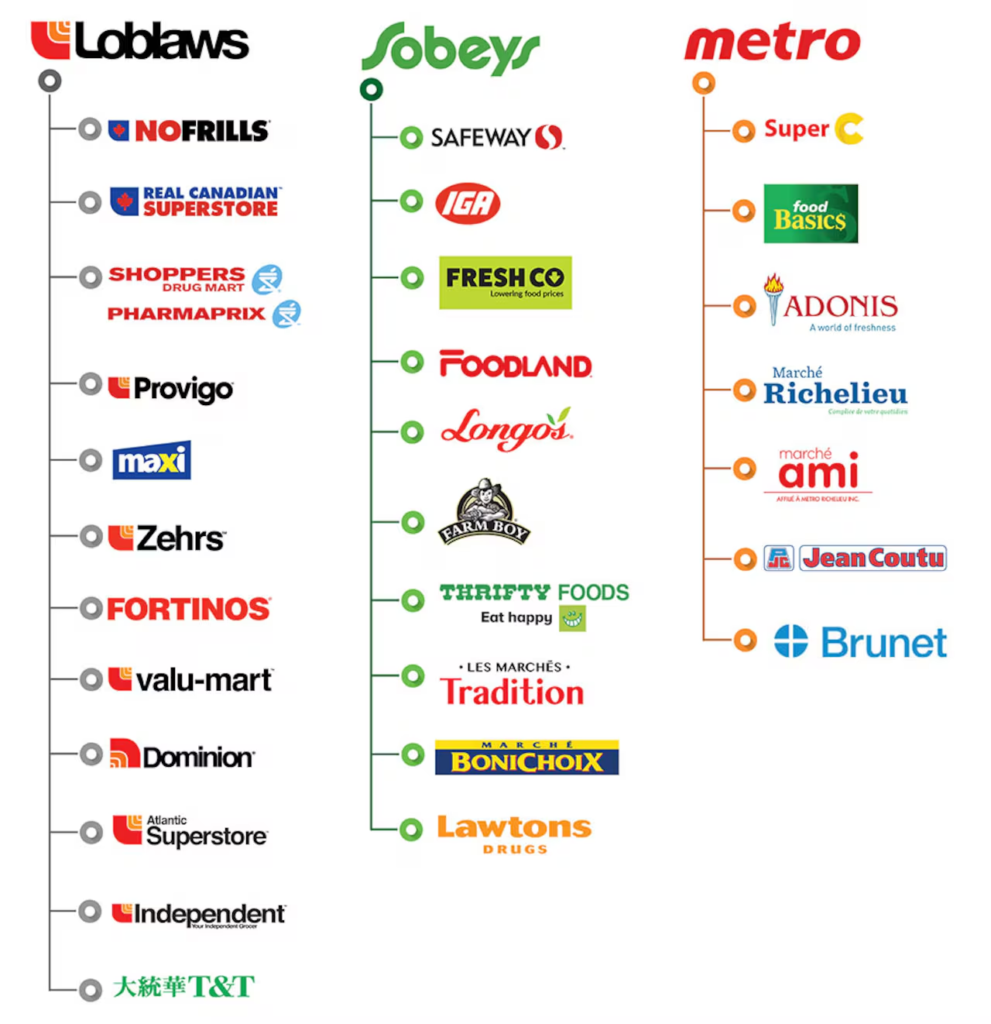
One major element is not mentioned in these back-and-forth debates: grocery monopolies. In October of last year, I reviewed The Big Fix: How Companies Capture Markets And Harm Canadians by Denise Hearn and Vass Bednar. In this book, we learn that five entities – Loblaws, Sobeys, Metro, Walmart, and Costco – comprise 80% of Canada’s food and consumer staples retail sector.
This illuminating chart I found in a June 2023 CBC article shows the incredible market dominance of Loblaws, Sobeys, and Metro:
Loblaws, owned by the Weston family dynasty, has drawn fire from many Canadian consumers. A reddit forum called /r/loblawsisoutofcontrol, which is “devoted to highlighting the ridiculous cost of living in Canada right now”, has grown to 78,000 subscribers. Users expose and mock Loblaws and other monopolies for the flagrant disregard they show towards both customers and employees.
In one post, a user shows how they bought a pancake mix marketed as 400 grams, only to bring it home and measure it with their own scale to find that it was merely 205 grams. Another post titled “Congrats on giving half a decade of your life to us” highlights how a Loblaws employee got some PC Optimum points, a fruit tray, and a pin in recognition for five years of work.
When a market is controlled by a handful of powerful, monopolistic behemoths instead of hundreds or thousands of smaller players, price fixing becomes easy – perhaps inevitable. In 2017, the Competition Bureau announced an investigation into a bread price-fixing scheme among major players in the Canadian market. Here’s a summary in the Globe and Mail:
“Canada’s top two bread makers, Canada Bread and Weston Bakeries, agreed to increase their wholesale bread prices in lockstep through direct communications between senior officials in each of their companies during a 14-year period, according to allegations in court documents released in connection with the Competition Bureau’s inquiry into the fixing of bread prices.

Then each of the bread producers met individually with their retail customers to get them to accept the fixed price ‘thereby fixing the retail price,’ according to a filing.
The retailers alleged to be part of the price-fixing scheme are major grocers Loblaw Cos. Ltd., Sobeys Inc., Metro Inc.; Wal-Mart Canada Corp. and Giant Tiger. The bread makers are Canada Bread Co. Ltd. and Weston Bakeries, which is owned by George Weston Ltd., which is the parent of Loblaw.”
An analysis in Maclean’s comparing the divergence between the price of milled flour and bread products over the course of the price-fixing scheme is damning:
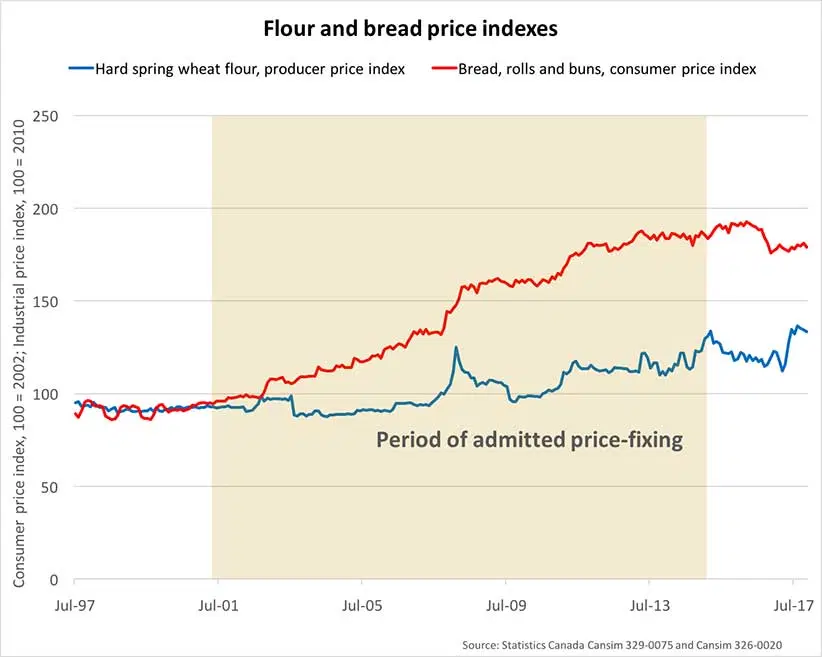
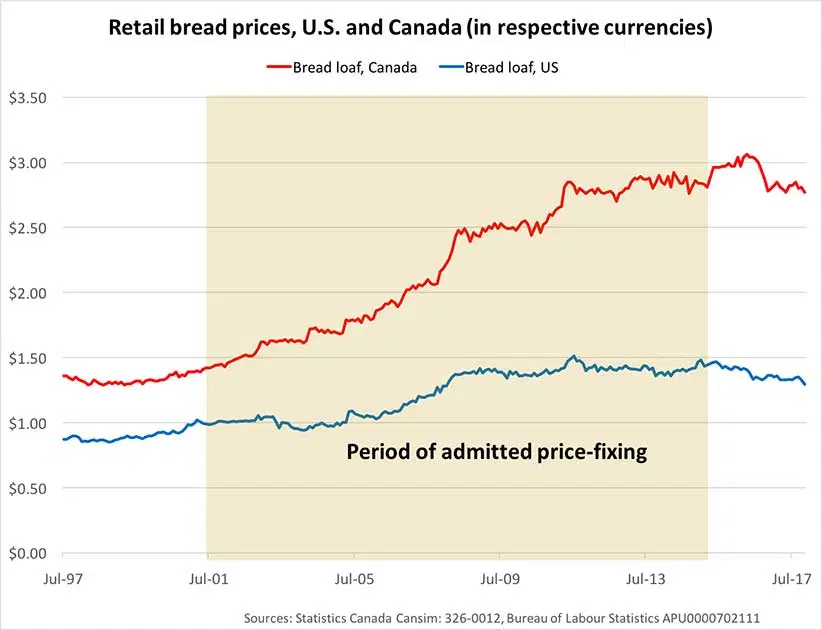
The evidence becomes even more damning when you compare the price increase of bread in the US and Canada – two countries where the price trajectory of groceries should typically be closely tied (with the exception of supply management sectors like dairy).
The Maclean’s analysis found that, during the price-fixing scheme, Canadian bread prices became totally detached from US prices:
Canadians are entitled to $50 from a class action lawsuit related to the price-fixing scandal. This might come as a small consolation, when estimates of how much the price-fixing scheme cost Canadians range from $400-$1,170. The crucial point here is that this price-fixing scheme went undetected for more than a decade – how many more such schemes are in operation right now, and for how many items? And how many other ways are prices being inflated by Canada’s grocery monopolies?
Why are the big grocery monopolies so seldomly addressed in the House of Commons these days? One explanation may be the troubling connections between these corporate monopolies and Canada’s major political parties. While money is not a major force in Canadian politics, thanks to tight limits on individual donations and a ban on corporate donations, some of the grocery monopoly families have nevertheless used their allowable donations to the maximum, according to a report in The Breach:
“The families and CEOs behind Canada’s largest grocery retailers have donated more than $150,000 to the Liberal and Conservative Party over the last two decades, data from Elections Canada shows.
That puts the owners of Loblaw and Empire among the top political donors in the country, according to a political financing expert.
Corporations have been banned from giving to federal parties since 2004, but that hasn’t stopped billionaire families like the Westons (owners of Loblaw) and Sobeys (owners of Empire) from frequently giving the maximum annual amount allowed.
These families split the spoils fairly evenly between the Conservative [sic] and Liberals, indicating they think of donations as a down payment to ensure corporate-friendly policies from both parties.”
Additionally, there is a significant crossover between grocery monopoly lobbyists and politicians, according to this Investigative Journalism Foundation (IJF) report:
“As federal Liberals and Conservatives fight to distance themselves from Canada’s biggest grocer, a new IJF analysis has found Loblaw packs its lobbying ranks with people who know first-hand the inner workings of government.
Nearly 60 per cent of the people Loblaw companies have hired to lobby federally, in Ontario and in B.C. since 2006 previously worked for Conservative, Liberal or NDP administrations.”
All content on this website is copyrighted, and cannot be republished or reproduced without permission.
Share this article!



The truth does not fear investigation.
You can help support Dominion Review!
Dominion Review is entirely funded by readers. I am proud to publish hard-hitting columns and in-depth journalism with no paywall, no government grants, and no deference to political correctness and prevailing orthodoxies. If you appreciate this publication and want to help it grow and provide novel and dissenting perspectives to more Canadians, consider subscribing on Patreon for $5/month.
- Riley Donovan, editor