The U.S. intention of the annexation of Canada preceded the adoption of the Constitution of the United States on September 17, 1787 at the Constitutional Convention and ever since this intention has been a recurring issue.
“In 1777, soon after declaring American independence, the Founding Fathers included in the young nation’s Articles of Confederation a direct invitation to colonists to the North to join the newly formed country, so long as they ended their relationship with Britain. The invitation stood open until the U.S. Constitution was ratified in June 1788 and a new government took office in March 1789.” (Source: Jordan Friedman in History.com)
“ARTICLE XI. Canada acceding to this confederation, and 1231.12 joining in the measures of the United States, shall be admitted into, and entitled to all the advantages of this union: but no other colony shall be admitted into the same, unless such admission be agreed to by nine states.”
Obviously “even before the United States became a country, its leaders had their eyes on the colonies to the north. Army commander George Washington sent troops led by Benedict Arnold to capture Quebec during the Revolutionary War in an unsuccessful bid to get Canadians to join the rebel cause.
During the War of 1812, there were multiple U.S. attempts to capture parts of Canada. And by the mid-19th century, Secretary of State William Seward made clear his belief that the United States was destined to expand northward. Most in the Great White North consistently rejected the idea of becoming part of the United States. Some historians argue this sentiment contributed to the 1867 decision of three British North American colonies—Nova Scotia, New Brunswick and the Province of Canada—to unite and form a self-governing Dominion of Canada.” (Source: Jordan Friedman in History.com)
“In September 1860, while giving a campaign speech in St. Paul, Minnesota, Seward looked north toward America’s neighbors and openly shared his vision of continental annexation:

‘I see how the East and the West are gathering to bind together this great continent… I look north, and there I see the British possessions… It is very well; you are building excellent states to be hereafter admitted into the American Union.‘” (Source: History.com)
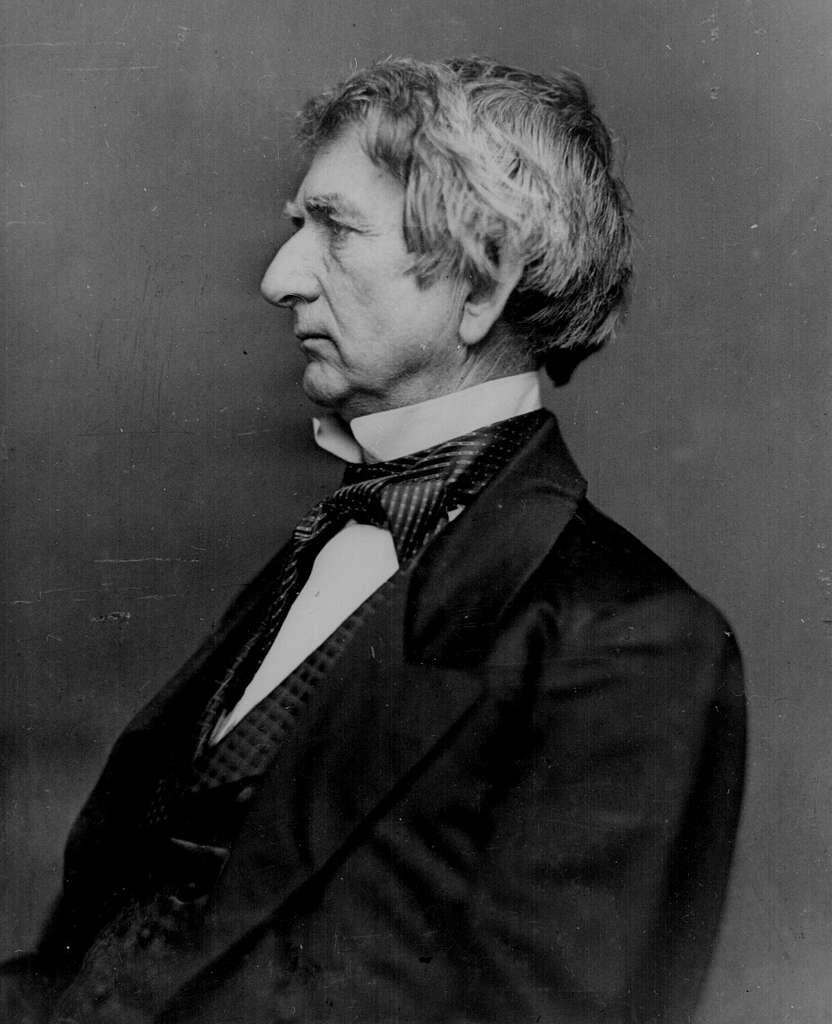
“Seward was a staunch believer in American expansionism. He genuinely believed it was the “inevitable destiny” of the United States to eventually absorb all of North America, including Canada, Russian America (which he later purchased as Alaska), and parts of the Caribbean.
The Reciprocity Treaty of 1854: Seward supported free trade measures between the U.S. and British North America because he believed that tying Canada’s economy closely to the United States would naturally pave the way for political annexation. (Emphasis added)
The Canadian Reaction: Comments like Seward’s did not sit well with British North Americans. In fact, American rhetoric regarding annexation—compounded by aggressive U.S. posturing during and after the American Civil War—deeply alarmed Canadian politicians. This profound fear of being swallowed up by the United States became a massive driving force that pushed the fragmented British provinces to unite, directly accelerating the Confederation of Canada in 1867” (Source: PrimaryDocuments.ca)
“Abraham Lincoln was elected in November 1860. William Seward was Lincoln’s Secretary of State. Expansion of the U.S.A. was one of Seward’s goals.
In 1860, the U.S. government created an annexation map of the Colony of British Columbia. Three years earlier, the Fraser/Cariboo Gold Rush, created an influx of American gold miners. Britain was concerned about the sudden large population of Americans and the threat of Britain losing this territory. The Colony of British Columbia was created in 1858 in response to this threat” (Source: David Gregory in Nunavut News)
Clearly the intention of acquiring Canada has been a persistent preoccupation of American leaders since the formation of the U.S. Confederation. But no American leader in the past has expressed the intention of annexation of Canada with such vulgarity as Donald Trump. Yet he may have unwittingly done Canada a favor by awakening the strong sense of normally dormant nationalism among the people of Canada. And by creating barriers to free trade through his tariffs he may have alerted Canada to reverse the process of economic integration that William Seward hoped would naturally pave the way for political annexation of Canada.
All content on this website is copyrighted, and cannot be republished or reproduced without permission.
Share this article!



The truth does not fear investigation.
You can help support Dominion Review!
Dominion Review is entirely funded by readers. I am proud to publish hard-hitting columns and in-depth journalism with no paywall, no government grants, and no deference to political correctness and prevailing orthodoxies. If you appreciate this publication and want to help it grow and provide novel and dissenting perspectives to more Canadians, consider subscribing on Patreon for $5/month.
- Riley Donovan, editor